






Overview

Type Two represents the archetype of the person who seeks to please others as a way to evoke affection. The drive to win others’ approval through indirect methods, such as seduction and strategic giving, is a way to obtain emotional and material support without having to ask for it. This strategy also provides a way to try to get others to take care of you while still defending yourself against the pain of having someone important reject a direct request to meet a need.

Twos can be of either gender, of course, but the Type Two archetype mirrors the Jungian concept of “anima,” or the inner feminine. Jung described the anima as being like a “glamorous, possessive, moody, and sentimental seductress.” Related to the Great Mother or the Great Goddess archetypes, the archetypal feminine principle represents fundamental human ideas about the all-powerful, numinous woman who provides vital nourishment, and displays the feminine qualities of warmth, receptivity, softness, emotional sensitivity, and openness to the other.

An element of this Two archetype can also be found in the caricature of the “Jewish mother” who is superficially selfless as a way to exercise emotional control over everyone close to her. It also fits the pattern of the classic “codependent”—the person who becomes addicted to supporting and enabling an addict. For each, below the surface, the giving is not an altruistic kind of helpfulness. These individuals find self-worth in being needed by those they value and (unconsciously) seek to get their own needs met in return. Their aid constitutes a strategic means of getting needs met through promises of reciprocal care, which sometimes involves promising more than can be delivered.

Type Twos are thus the prototype for that part in all of us that adopts an elevated or idealized view of ourselves and our ability to make others like us. A tendency toward self-aggrandizement or self-inflation undergirds the Type Two’s persona. Twos often appear boundlessly and indispensably generous, helpful, attractive, and supportive. The false self that Twos model is one seeking to create positive connections with others through an attractive and inviting front.

This false self engineers positive emotional alignment with people who then provide support for survival. Once a friendly relationship has been established, that human link may be used as a resource in a time of need. The Two archetype illustrates the idea that when you want something from others to support your well-being, “you can catch more flies with honey than with vinegar;” charm and helpfulness in the present provide a good groundwork for asking for favors in the future.

The natural strengths of Type Twos include their genuine ability to listen to others, empathize with their feelings, and meet their needs. They are usually cheerful, optimistic, warm, and friendly. Twos are naturally practiced in the art of using positive communication to create rapport. They can be very diplomatic and skilled at delivering messages in ways that people can hear. Twos’ particular “superpower” is that they can be excellent friends and will often go to great lengths to take care of and support loved ones. Twos can also be driven and energetic, extremely competent people who get a lot of things done and strive to do things well, especially as a way to impress others.

As with all the archetypal personalities, however, Type Twos’ gifts and strengths also represent their “fatal flaw” or “Achilles heel.” Their focus on appearing to be powerful enough to “do anything” for others leads to self-inflation. This inflation is a form of pride—the passion of the Two. This pride also masks the Two’s denial of the very needs that motivate seduction. As a result, they end up denying their own needs and losing a clear sense of how they really feel.

Twos can be upbeat, friendly, and genuinely giving. But at times they may get in their own way by overdoing their focus on shape-shifting to please others. For instance, Twos can’t help imagining that other people are as sensitive to criticism as they are. So they may sugarcoat or shade the truth out of fear of hurting someone. Other times, a Two’s cheeriness can feel false, as it sometimes functions as an overcompensation to mask sadness, resentment, or disappointment.

Focus of Attention

Twos focus on relationships, gaining approval, and seducing others through helpfulness as a strategic way to get their disowned needs met.

Twos actively “read” the people around them and align with (what they perceive to be) their moods and preferences in order to maximize the potential for positive connection.

They notice errors, inconsistencies, and imperfections that others might overlook. This keen eye for improvement can be both a gift and a burden, as they often feel responsible for correcting what they perceive as wrong.

Thoughts and Emotions

Emotionally, Twos fear rejection and so they frequently repress their feelings in an effort to please others. When their emotions can no longer be repressed, they may display anger, sadness, anxiety, or hurt. Because of these contradictory impulses, Twos may feel emotionally conflicted. Twos also express happy feelings as a way of appearing likable to others.

Behaviour Patterns

Twos tend to be upbeat, energetic, and friendly, though sometimes this can mask (and be an overcompensation for) repressed needs and a tendency toward depression. 9ey are driven and hardworking, especially in the service of others or a project they feel passionate about, but they can also be hedonistic and self-indulgent. Twos may also play the role of martyr, sacrificing their own needs and desires to win over others, but then suffering for it.

Blind Spots

Common Blind Spots
When Blind Spots Are Integrated

The Passion is Pride

Pride

In the language of the Enneagram, pride functions as a need for self-inflation and gets expressed as a false generosity in the service of seduction and self-elevation. Pride also fuels a pattern of self-idealization and grandiosity, followed by a reactive devaluation and self-criticism.

The Virtue is Humility

Humility

Humility gives this type a clear goal to work toward a6er acknowledging their habitual patterns that stem from pride and the search for love. By working against the tendencies fueled by pride and trying to embody the qualities of humility, they wake up and move closer to their real selves.

Discover Your Full Personality Profile

Get a comprehensive analysis of your type, including personalized growth strategies and relationship insights.

Growth Path

For Type Twos, the first stage of awakening involves actively and consciously observing how they tune in to others’ feelings more than their own. When they intentionally watch their habitual patterns in action, like how they please others to get something from them while trying to appear selfless and altruistic they initiate their own awakening.

As a Type Two, your growth journey starts with developing the capacity to recognize how much attention you give to others and how little attention you pay to your own priorities without judging yourself. This helps you become aware of all the ways you rely on the approval of others to inform your sense of who you are.

Wings and Arrows

In using the Enneagram to further growth, as it is intended, the first steps involve observing yourself to make the patterns and habits associated with your main, or “core,” type more conscious.

After you have done this for a while, you can create further growth shifts by using the wings and arrows as pathways for growth.

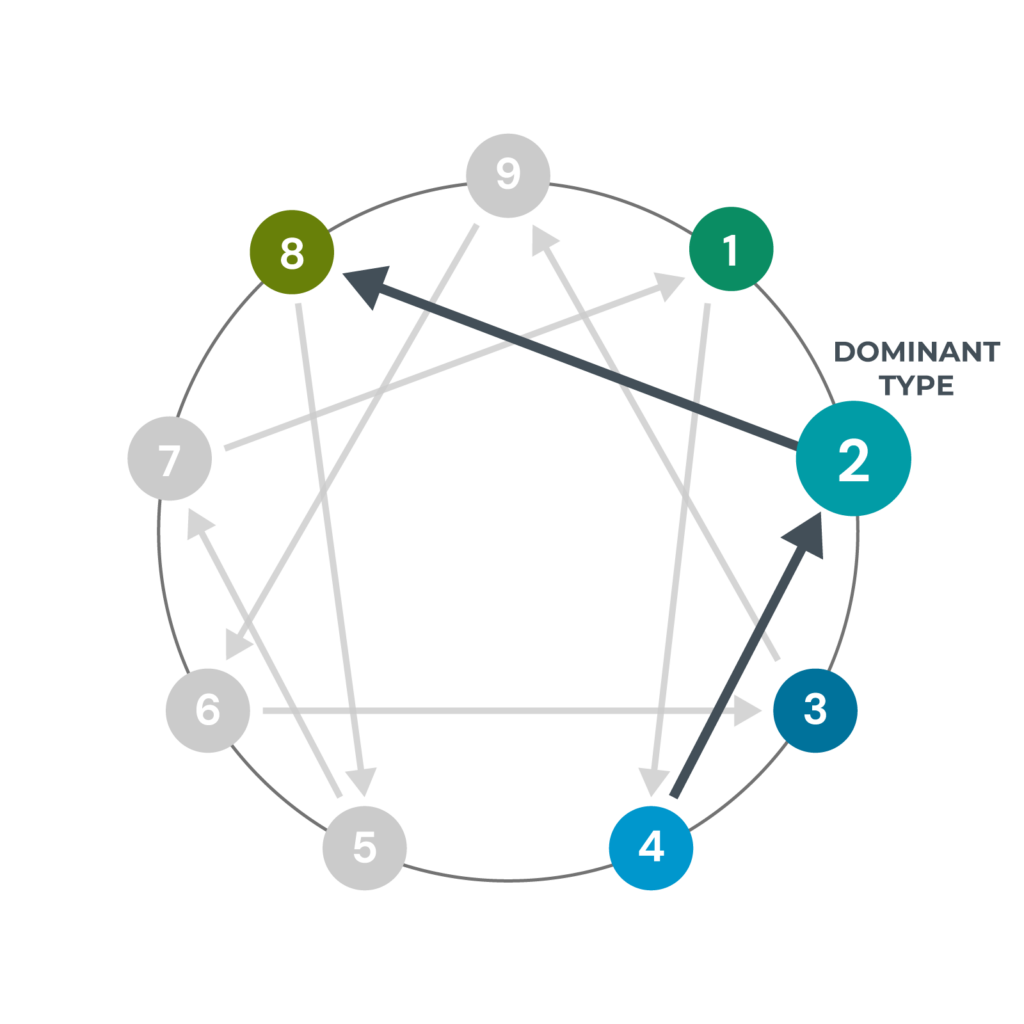
The Enneagram’s arrow lines point in the direction of each type’s specific path of psychological and spiritual growth and away from important characteristics and experiences we had to repress in childhood (but periodically return to for a sense of security). These connection points indicated by the Enneagram diagram help us see how we can aim to embody the higher aspects of these two specific points to further our inner journey: the point ahead of our core point represents key challenges we need to master to become more whole and the point behind our core type along the arrow lines represents issues from the past that we need to re-integrate such that we can reclaim what we disowned in childhood to ground and support our forward movement along the path indicated by the arrows.

Moving Back to Type 4

The path of growth for Twos calls for them to reclaim their needs and feelings as represented by the Four Point. Many Twos received the message early on that their needs and emotions were too much. In keeping with the coping strategy of adapting emotionally to others, Twos typically respond to this by repressing their emotions and disowning their needs as a way of maintaining connections. By consciously drawing on the strengths of Type Fours, Twos can expand their access to their authentic emotions, reclaim a healthy ability to self-reference (to balance out their disproportionate focus on others), and accept and express their needs with more confidence.

If Twos have been made to feel shame for their needs and feelings, as many have been, it can be important and healing for them to incorporate the Four stance that feelings are important and valuable expressions of your authentic self. By encouraging a shift of focus from others to self, the Two “move to Four” allows Twos to ground themselves in the legitimacy of their real feelings and needs, thereby strengthening their connection to their own inner knowing and their sense of self. Twos often experience an underlying sense of anxiety related to deep beliefs from childhood that their normal needs and feelings threaten their connections with the important people in their lives. The Two move to Four can help Twos relax in the knowledge that honoring their emotions and desires can support, rather than thwart or threaten, their ability to form positive relationships.

Navigated consciously, Twos can use the higher wisdom of the Four Point to establish a healthy balance between focusing on the self and focusing on others; between expressing sadness and hurt and cultivating a sense of lightness; and between meeting others’ needs and asking for what they need. They can consciously remind themselves that although it is often important to make room to empathize with others’ emotions, all their own feelings are valid and valuable as well.

Moving Ahead to Type 8

Type Twos’ Inner Flow growth path brings them into direct contact with the challenges embodied in Type Eight: owning their power and authority, allowing for more access to anger, and handling conflict and confrontation more consciously. Twos are typically more comfortable being the power behind the throne, but moving to Eight invites them to initiate more and to take the risk of leading and acting proactively rather than always reacting. Crucially for Twos, moving to Eight also means learning to be more direct and assertive as opposed to using indirect means to get needs met and sugarcoating messages to make them go down easier.

While it can be difficult at first for Twos (especially Self-Preservation Twos) to imagine themselves feeling comfortable with being authoritative, aggressive, and direct when appropriate, incorporating healthy Type Eight behaviors can provide a much-needed balance to Twos’ habit of getting needs met covertly through seduction, charm, and strategic helpfulness. Eights’ strength and self-confidence help Twos value themselves and be more bold in the things they do. Twos see their real power in helping and supporting others, and while this a legitimate strength, they can overdo the strategy of emotional support and underestimate the power of exercising authority in more direct ways. Focusing on embodying more of the Eight Point expands the range of ways Twos can make an impact on others, and it allows for more freedom in how they interact with others. Seeing conflict as a good thing—as a way of having positive contact through the exploration of legitimate differences—can also counter their tendency to merge emotionally with others.

Type Two Subtypes

Each Enneagram type is influenced by three instinctual drives that create distinct expressions of the type:

Self-Preservation Two

Privilege

Self-Preservation Twos “seduce” like a child in the presence of grown-ups as a way of (unconsciously) inducing others to take care of them. Everyone likes children, and the SP Two adopts a youthful stance as a way of getting special treatment well beyond childhood. As the countertype, it’s less easy to see pride in this Two because they are more fearful of and ambivalent about connecting with others. The title “Privilege” reflects this Two’s desire to be loved and prioritized just for being who they are, not for what they give to others. Related to the youthful stance, these Twos are playful, irresponsible, and charming.

Social Two

Ambition

The Social Two is a seducer of environments and groups—a powerful, leader type whose pride manifests as a sense of satisfaction in the conquest of an audience. This is a more adult Two in whom pride is the most obvious; the Social Two cultivates an image of being an influential, super-competent person worthy of admiration. The name “Ambition” reflects this person’s desire to “be on top,” and as a result of this lofty position, receive advantages and benefits. This Two “gives to get” the most and always has a strategic angle when expressing generosity.

Sexual/One-to-One Two

Seduction-Aggression

Sexual Twos seduce specific individuals as a way of getting needs met and feeding their pride. Similar to the “femme fatale” archetype (and male equivalent) this Two employs the methods of classical seduction to attract a partner who will meet all their needs and give them whatever they want. The name “Aggressive-Seductive” suggests a character who is appealing, but who also wants to wield some power. Energetically like a force of nature, this is a person who becomes irresistible, who inspires great passions and positive feelings as a way to meet needs in life.

Continue Your Enneagram Journey

Discover more insights about Type One and explore how the Enneagram can transform your personal and professional relationships.

Get Full Report

Unlock your complete personality profile with detailed insights and growth strategies.

Team Development

Apply Enneagram insights to improve team dynamics and communication in your organization.

Coaching Sessions

Work with a certified Enneagram coach to accelerate your personal growth journey.

About the Enneagram

Enneagram Compass logo
What is the Enneagram?

Learn about how the Enneagram can help you better understand yourself and others.

3 Centers icon
Introduction to the 3 Centers

Discover the Head, Heart, and Body Centers and how they shape your core responses to the world.

Nine Types icon
Introduction to Nine Types

An overview of the nine Enneagram types and the unique traits that define each one.

3 Instincts icon
The 3 Instincts

Explore the three key instincts—Self-preservation, Social, and Sexual—and their influence on you.

27 SubTypes icon
Introduction to the 27 SubTypes

Explore the Enneagram’s 27 subtypes and how they refine the nine core types.​

Publications icon
Publications

Access books, articles, and resources from leading Enneagram experts to deepen your understanding.

Privacy Policy

We are fully compliant with the General Data Protection Regulation. Our servers are located within the EU so no data is sent outside the EU jurisdiction. Every individual has rights as to how their personal data is handled, and we recognize the need to treat all such data in an appropriate and lawful manner, according to the classification of such data. Personal data, including sensitive data, are subject to certain legal safeguards with the provisions under the GDPR and we fully comply with these legal guidelines.
 

All data (personal and otherwise) that we collect as a result of use of our Questionnaire based assessments is handled in accordance with the Privacy Policy outlined below and we can reassure you that we will not share that information for any use whatsoever other than to provide the service for which we have been contracted. This statement explains how we use the personal information that you give us. Please do not send us any personal data about anyone else without their permission.

 
Future Research and Direct Marketing Communications
 

We would like to be able to contact you in future with details of research projects we may be conducing; or in relation to further products and services that we think you may be interested in. We will only send you further emails in regards to our future research projects or marketing communications if you directly consent to us doing so- there is a specific question that asks for your consent. We will always contact you by email or other electronic means. We will treat your personal details with the utmost care and will never sell them to other companies for marketing purposes

We use MailChimp to send our email newsletters. By signing up to receive our email communications, you agree to the transfer of data to MailChimp and Active Campaign.

Updating Your Data, Erasure, and Requesting a Copy of Your Records
 

If you would like to:

  • Update your details
  • Withdraw your consent/opt out of marketing communications
  • Request erasure of the data we hold on you
  • Request a copy of the data records we hold on you (we will endeavour to fulfil the request within twenty four hours but no more than 14 days)

Please contact info@enneagramprofiling.com and we will respond within 48 hours.

Cookies

This site uses cookies – small text files that are placed on your machine to help the site provide a better user experience. In general, cookies are used to enable a client to return to the same place within a questionnaire should they be interrupted and have to discontinue the session.

Cookies can also be used to store information for things like shopping carts, and provide anonymised tracking data to third party applications like Google Analytics. As a rule, cookies will make your browsing experience better. We will send you a link to continue the questionnaire so cookies are not essential for you to enjoy our services. It may be that you may prefer to disable cookies on this site and on others. The most effective way to do this is to disable cookies in your browser. We suggest consulting the Help section of your browser or taking a look at the About Cookies website which offers guidance for all modern browsers

Data Security

At Enneagram Compass we demand the highest levels of data security. Our server provider has achieved ISO 27001 certification. We use Transport Layer Security (TLS) encryption (also known as HTTPS) for all transmitted data. Surveys can be protected with passwords and HTTP referrer checking. Our services are hosted by trusted data centres that are independently audited using the industry standard SSAE-16 method. The servers are protected by high-end firewall systems, and scans are performed regularly to ensure that any vulnerabilities are quickly found and patched.

In order to comply with GDPR we understand that data collected from the participant’s PC in Europe cannot be transferred to a server in another jurisdiction such as the US. So that we do not breach EU data protection law our server is located in Ireland. The data we collect in Europe is therefore stored and processed in Europe and is not moved to another jurisdictional area.

Disclosure – Sharing Your Data

We will not disclose your personal information to third parties except:

  • as necessary to fulfil your order(s) for our goods and services and to validate your payment details;
  • to suppliers that process data on our behalf;
  • to your coach or enneagram consultant who purchased a test on your behalf where we believe, in good faith, that it is necessary to comply with the law or to protect the safety of Enneagram Profiling, our customers or their clients, or the public.

We may use and disclose aggregated and anonymised information for marketing, product development, strategic or research purposes. In such data, no individual customer will be identifiable.

Credit Card Payments

For those using the site to purchase access to our services Stripe and PayPal are used to collect personal information related to credit card processing including . Full Name, Email Address, Billing Address, Credit Card number.

Stripe’s services in Europe are provided by a Stripe affiliate—Stripe Payments Europe Limited (“Stripe Payments Europe”)—an entity located in Ireland. In providing Stripe Services, Stripe Payments Europe transfers personal data to Stripe, Inc. in the US. To ensure the adequate protection of personal data, we have certified to the EU-U.S. and Swiss-U.S. Privacy Shield.

PayPal are still to provide their understanding of whether they are fully GDPR compliant. Their privacy policy can be read here https://www.paypal.com/uk/webapps/mpp/ua/privacy-prev . PayPal argue that they are compliant with various financial regulation laws but we suggest not using PayPal if this is something you are concerned about.

Sending Result Reports to a Third Party

Where an individual takes one of our instruments under the direction of one of our professional customers, (such as a consultant, a coach, a line manager, an Enneagram teacher etc.) and Enneagram Compass performs a service hosting, administering and scoring that instrument for the customer, then we will send the individual’s results to that customer in order that they may provide appropriate feedback, or similar service, to the individual who took the instrument. By taking the questionnaire you are giving permission for that Third Party to receive a copy of your report. In completing the questionnaire you are agreeing for the report to be sent to such a third party. We at Enneagram Profiling assume that the data will be used for the sole purpose of aiding your understanding of the Report, and in order for you to derive maximum benefit from the process. However, we do not accept any responsibility whatsoever for the actions of our third-party customers who have ordered the questionnaire and results report on your behalf. Enneagram Profiling is therefore not responsible for the use, storage or distribution of such data, or the consequences thereof that may arise as a result of the use of the report.

Retention Period – Anonymisation

Links to Other Sites