






Overview

Type Three represents the archetype of the person who seeks to create an image of value and success and to gain the admiration of others, through active efforts in both work and appearance. This drive provides defensive protection in a world that rewards achievement and attractiveness and emphasizes what things look like on the outside. This archetype also exists as Jung’s concept of the “persona,” the individual’s “system of adaptation to, or the manner in which he assumes in dealing with, the world.” Taken from the term used to describe the mask worn by an actor, the persona is our conscious outer social face, the role we play, or the image we show to others “to give form to our outward sense of self.” The persona takes its form and function from external, collective reality.

Type Threes are the prototype for the way in which we all adopt a personality as an external public face in order to survive in the world and mediate between the inner self and the social environment. It is the model for the desire we all have to “put on a good face” or wear a social mask as a means of both protection and a marketing effort. This archetypal stance prioritizes looking good and matching social ideals of value and status as a way of feeling accepted and earning approval.

This effort also necessarily involves inhibiting or covering over aspects of the “real self” that don’t fit with the constructed social mask. Type Threes tend to lose contact with the deeper emotions they naturally have that might interfere with the design of the image they create for others and thus may become overidentified with their persona and under-identified with who they really are.

Type Three individuals work very hard and know how to make a good impression. They are extremely competent and effective doers who get a lot done and make it look easy (even though it requires much effort). Threes are skilled at using goals to motivate their efforts and are resourceful and productive in achieving those goals. They know how to present themselves to others and fit the image of whatever context they might be in. Their specific “superpower” is their ability to make things happen by finding the most direct path to their goal, removing obstacles that might get in the way—and looking good the whole time. They know how to assure their own success by working diligently, completing the tasks necessary to reach their goal, and exuding an image of success and competence.

As with all the archetypal personalities, however, Type Threes’ gifts and strengths also represent their “fatal flaw” or “Achilles heel:” they exhaust themselves by working too hard, and they lose sight of who they really are apart from the persona they’ve adopted to achieve their goals. And they can be hard-hearted and insensitive to others in their race to the finish line. However, when they can learn to balance their focus on work and achievement with a focus on the needs and feelings of their true self, they can blend their skill at actualizing goals with the creativity and depth of who they are, producing positive results that can enhance life for themselves and others.

Focus of Attention

Threes focus attention on tasks and goals to create an image of success in the eyes of others.

Threes identify with their work, believing they are what they do, and lose touch with who they really are.

Thoughts and Emotions

Thoughts and Emotions

For a Three, thinking centers on “doing”—on accomplishing tasks and goals. Though a heart type, Threes (unconsciously) avoid their feelings because getting caught up in emotion prevents them from getting things done. When they slow down enough for emotions to surface, they may feel a sense of sadness or anxiety related to being recognized for what they do and not for who they are. Threes tend to express impatient anger if someone or something gets between them and their goal.

Behaviour Patterns

Threes tend to be fast-paced workaholics. They find it very difficult to slow down and just “be.” They can be extremely productive and effective because of their laser-like focus on getting things done and reaching their goals.

Blind Spots

Common Blind Spots
When Blind Spots Are Integrated

The Passion is Self-Deceit

Self-Deceit

Self-deceit is the passion that drives Type Three. In its expression as the core emotional motivation of this type, self-deceit is an unconscious tendency to shapeshift to present themselves in a way others will approve of and admire. This type creates and maintains an ideal image or persona, and then identifies with (or sees themselves as) that persona.

The Virtue is Veracity

Veracity

Veracity is the virtue that provides an antidote to the Type Three passion of self-deceit. For this type, veracity involves being more fully conscious of the deception implicit in their personality structure. It means recognizing their false selves as false and learning not to find their identity in what others want them to be or how they would like to appear to others.

Discover Your Full Personality Profile

Get a comprehensive analysis of your type, including personalized growth strategies and relationship insights.

Growth Path

For Type Three, the key to embracing their true selves lies in gradually learning to know and like their authentic selves more than their egoic selves. This happens as they strengthen their sense of who they are without needing to take on a specific role or persona. When they become conscious of their tendency to deceive themselves and learn to catch themselves in the act of shape-shifting, they learn that their true selves can be available for love and connection while their false selves cannot.

When Type Threes take the journey of self-development, they can bring the richness of who they are to the world in ways they can’t even imagine. They realize that true success lies in their ability to know who they truly are and begin to live from a grounded sense of being in touch with their depths. And when they do this, they not only open the door to truly loving themselves, they make themselves available to be deeply loved by others for who they really are.

Wings and Arrows

In using the Enneagram to further growth, as it is intended, the first steps involve observing yourself to make the patterns and habits associated with your main, or “core,” type more conscious.

After you have done this for a while, you can create further growth shifts by using the wings and arrows as pathways for growth.

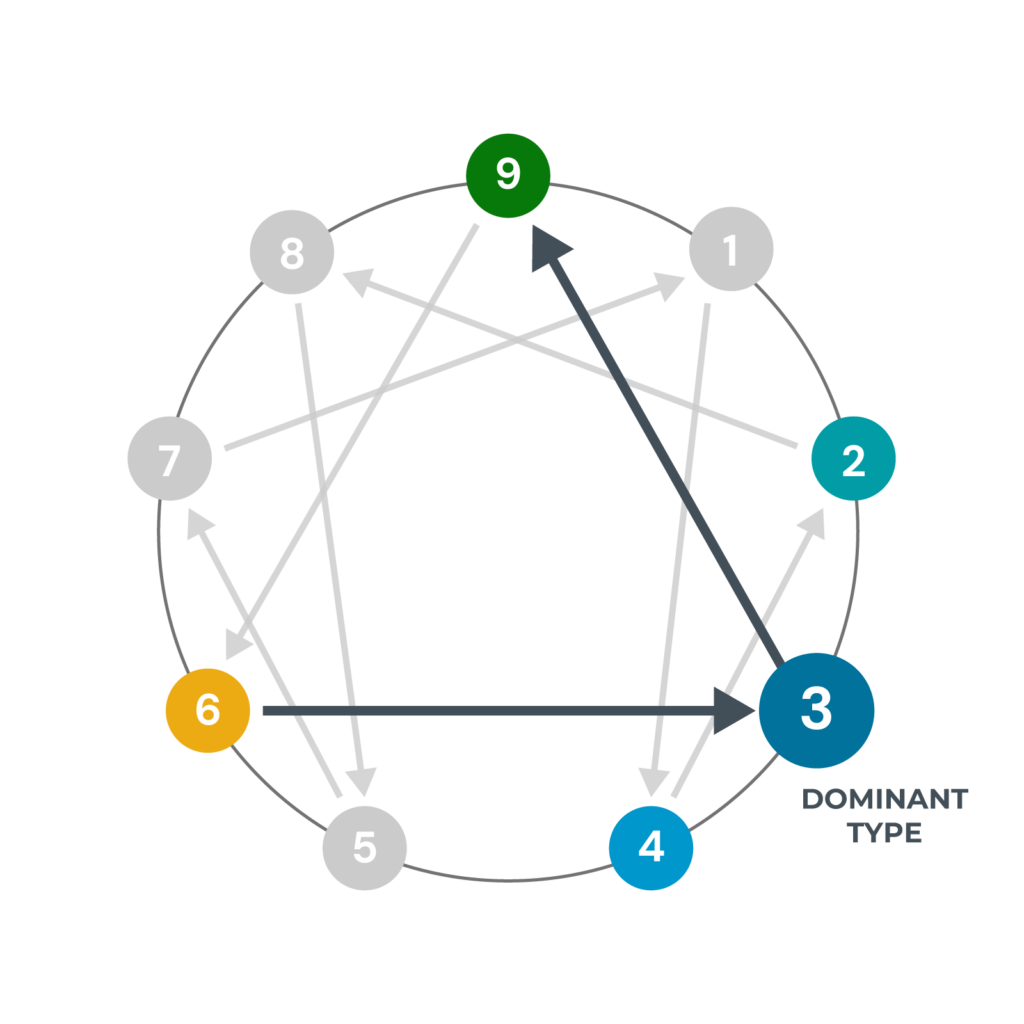
The Enneagram’s arrow lines point in the direction of each type’s specific path of psychological and spiritual growth and away from important characteristics and experiences we had to repress in childhood (but periodically return to for a sense of security). These connection points indicated by the Enneagram diagram help us see how we can aim to embody the higher aspects of these two specific points to further our inner journey: the point ahead of our core point represents key challenges we need to master to become more whole and the point behind our core type along the arrow lines represents issues from the past that we need to re-integrate such that we can reclaim what we disowned in childhood to ground and support our forward movement along the path indicated by the arrows.

Moving Back to Type 6

The path of growth for Type Threes calls for them to reclaim their ability to access their fears as a way of slowing down to more carefully consider the path to their goal. In response to a lack of protection early on, Threes often became doers, even if this required them to bury their anxieties as a way of finding security. Young Threes may have felt like they didn’t have the luxury of feeling their fear, so they coped by getting active to accomplish things. A conscious return to Six can be a way for them to allow themselves to get in touch with the fears and concerns that can force them to slow their pace in helpful ways. Pausing to reflect on potential threats and problems gives them more space to pay attention to their feelings and intuitions. For these reasons, “moving back to Six” can be a healthy way for Threes to make space for thinking through more aspects of their plans than they usually leave time for.

Navigated consciously, a Three can use the move to Six to re-establish a healthy balance between moving forward and pausing for reflection. They can consciously insert a healthy round of questioning before moving ahead so quickly, and they can make sure to assess what is happening at a deeper level than they normally do. Focusing on what they are afraid of can be a way for Threes to tap into a deeper emotional level within themselves, which can also be a way to highlight their need to allow for support from others. Threes can relax more if they don’t always need to be the one in control and can call on the high side of Six to have more faith in others, allowing someone else to take the lead in solving problems and providing protection. Questioning and self-doubt can be good for Threes in that it opens up a channel to the vulnerability they often hide behind an image of self-confidence. All of these efforts to increase awareness of the move to Six can provide Threes with a grounding in a deeper sense of themselves that will better equip them in their forward progress toward the high side of Type Nine.

Moving Ahead to Type 9

The Inner Flow growth path for Type Threes brings them into direct contact with the challenges embodied in Type Nine: allowing for being without doing, prioritizing others and not just goals and tasks, and being connected to people without losing yourself. Threes can find the move to Nine difficult, and they often go there unconsciously in times of stress when they have worked themselves to the point of collapse. But considered consciously, Threes can use the Nine-Point as a path of growth by learning to be more in their bodies, to include different points of view when completing a task, and to slow down and broaden their focus of attention. Nines are particularly good at “going with the flow,” and Threes are not usually happy unless they are directing the flow and controlling progress toward a goal. Threes can use the Nine-Point to consciously let go of their need to control things—to have things move forward at a certain pace in a certain way—and allow themselves to follow others more.

The Three working consciously in this way can make ready use of the tools healthy Type Nines use: a reliance on inclusion and consensus as important factors in getting the job done well, an ability to follow others’ lead and not always have to be the center of attention, and a sense of “gut knowing” as a way to direct their efforts. The ability of conscious Nines to take “right action” based on both deeply understanding others’ perspectives and taking their own gut knowing into account in directing forward movement can balance out the Three’s tendency to forge ahead and rush toward a goal without stopping to consider a wider range of opinions. The more passive stance of Type Nine can usefully counter the active approach usually taken by Threes. And Nines’ ability to relax and just be, helps Threes learn how to slow down the doing and risk being.

Type Three Subtypes

Each Enneagram type is influenced by three instinctual drives that create distinct expressions of the type:

Self-Preservation Three

Security

The Self-Preservation Three has a sense of vanity for having no vanity. This Three also wants to be admired by others but avoids openly seeking recognition. Not just satisfied with looking good, the SP three strives to be good. They are determined to be a good person—to match the perfect model of how a person should be. Being the perfect model of quality implies virtue, and virtue implies a lack of vanity. SP Threes seek a sense of security through being good, working hard, and being effective and productive.

Social Three

Prestige

Social Threes focus on achievement in the service of looking good and getting the job done. They act out vanity through their desire to be seen and have in-fluence with people. They enjoy being on stage in the spotlight. Social Threes know how to climb the social ladder and achieve success. These are the most competitive and most aggressive of the Threes. They have a driving need to look good and possess a corporate or sales mentality.

Sexual/One-to-One Three

Charisma

Sexual Threes focus on achievement in terms of personal attractiveness and supporting others. In this Three, vanity is not denied (as in the SP Three) nor embraced (as in the Social Three), but is somewhere in between: it’s employed in the service of creating an attractive image and promoting important others. These threes have a harder time talking about themselves and often put the focus on others they want to promote. They put a lot of energy into pleasing others and they have a family/team mentality.

Continue Your Enneagram Journey

Discover more insights about Type One and explore how the Enneagram can transform your personal and professional relationships.

Get Full Report

Unlock your complete personality profile with detailed insights and growth strategies.

Team Development

Apply Enneagram insights to improve team dynamics and communication in your organization.

Coaching Sessions

Work with a certified Enneagram coach to accelerate your personal growth journey.

About the Enneagram

Enneagram Compass logo
What is the Enneagram?

Learn about how the Enneagram can help you better understand yourself and others.

3 Centers icon
Introduction to the 3 Centers

Discover the Head, Heart, and Body Centers and how they shape your core responses to the world.

Nine Types icon
Introduction to Nine Types

An overview of the nine Enneagram types and the unique traits that define each one.

3 Instincts icon
The 3 Instincts

Explore the three key instincts—Self-preservation, Social, and Sexual—and their influence on you.

27 SubTypes icon
Introduction to the 27 SubTypes

Explore the Enneagram’s 27 subtypes and how they refine the nine core types.​

Publications icon
Publications

Access books, articles, and resources from leading Enneagram experts to deepen your understanding.

Privacy Policy

We are fully compliant with the General Data Protection Regulation. Our servers are located within the EU so no data is sent outside the EU jurisdiction. Every individual has rights as to how their personal data is handled, and we recognize the need to treat all such data in an appropriate and lawful manner, according to the classification of such data. Personal data, including sensitive data, are subject to certain legal safeguards with the provisions under the GDPR and we fully comply with these legal guidelines.
 

All data (personal and otherwise) that we collect as a result of use of our Questionnaire based assessments is handled in accordance with the Privacy Policy outlined below and we can reassure you that we will not share that information for any use whatsoever other than to provide the service for which we have been contracted. This statement explains how we use the personal information that you give us. Please do not send us any personal data about anyone else without their permission.

 
Future Research and Direct Marketing Communications
 

We would like to be able to contact you in future with details of research projects we may be conducing; or in relation to further products and services that we think you may be interested in. We will only send you further emails in regards to our future research projects or marketing communications if you directly consent to us doing so- there is a specific question that asks for your consent. We will always contact you by email or other electronic means. We will treat your personal details with the utmost care and will never sell them to other companies for marketing purposes

We use MailChimp to send our email newsletters. By signing up to receive our email communications, you agree to the transfer of data to MailChimp and Active Campaign.

Updating Your Data, Erasure, and Requesting a Copy of Your Records
 

If you would like to:

  • Update your details
  • Withdraw your consent/opt out of marketing communications
  • Request erasure of the data we hold on you
  • Request a copy of the data records we hold on you (we will endeavour to fulfil the request within twenty four hours but no more than 14 days)

Please contact info@enneagramprofiling.com and we will respond within 48 hours.

Cookies

This site uses cookies – small text files that are placed on your machine to help the site provide a better user experience. In general, cookies are used to enable a client to return to the same place within a questionnaire should they be interrupted and have to discontinue the session.

Cookies can also be used to store information for things like shopping carts, and provide anonymised tracking data to third party applications like Google Analytics. As a rule, cookies will make your browsing experience better. We will send you a link to continue the questionnaire so cookies are not essential for you to enjoy our services. It may be that you may prefer to disable cookies on this site and on others. The most effective way to do this is to disable cookies in your browser. We suggest consulting the Help section of your browser or taking a look at the About Cookies website which offers guidance for all modern browsers

Data Security

At Enneagram Compass we demand the highest levels of data security. Our server provider has achieved ISO 27001 certification. We use Transport Layer Security (TLS) encryption (also known as HTTPS) for all transmitted data. Surveys can be protected with passwords and HTTP referrer checking. Our services are hosted by trusted data centres that are independently audited using the industry standard SSAE-16 method. The servers are protected by high-end firewall systems, and scans are performed regularly to ensure that any vulnerabilities are quickly found and patched.

In order to comply with GDPR we understand that data collected from the participant’s PC in Europe cannot be transferred to a server in another jurisdiction such as the US. So that we do not breach EU data protection law our server is located in Ireland. The data we collect in Europe is therefore stored and processed in Europe and is not moved to another jurisdictional area.

Disclosure – Sharing Your Data

We will not disclose your personal information to third parties except:

  • as necessary to fulfil your order(s) for our goods and services and to validate your payment details;
  • to suppliers that process data on our behalf;
  • to your coach or enneagram consultant who purchased a test on your behalf where we believe, in good faith, that it is necessary to comply with the law or to protect the safety of Enneagram Profiling, our customers or their clients, or the public.

We may use and disclose aggregated and anonymised information for marketing, product development, strategic or research purposes. In such data, no individual customer will be identifiable.

Credit Card Payments

For those using the site to purchase access to our services Stripe and PayPal are used to collect personal information related to credit card processing including . Full Name, Email Address, Billing Address, Credit Card number.

Stripe’s services in Europe are provided by a Stripe affiliate—Stripe Payments Europe Limited (“Stripe Payments Europe”)—an entity located in Ireland. In providing Stripe Services, Stripe Payments Europe transfers personal data to Stripe, Inc. in the US. To ensure the adequate protection of personal data, we have certified to the EU-U.S. and Swiss-U.S. Privacy Shield.

PayPal are still to provide their understanding of whether they are fully GDPR compliant. Their privacy policy can be read here https://www.paypal.com/uk/webapps/mpp/ua/privacy-prev . PayPal argue that they are compliant with various financial regulation laws but we suggest not using PayPal if this is something you are concerned about.

Sending Result Reports to a Third Party

Where an individual takes one of our instruments under the direction of one of our professional customers, (such as a consultant, a coach, a line manager, an Enneagram teacher etc.) and Enneagram Compass performs a service hosting, administering and scoring that instrument for the customer, then we will send the individual’s results to that customer in order that they may provide appropriate feedback, or similar service, to the individual who took the instrument. By taking the questionnaire you are giving permission for that Third Party to receive a copy of your report. In completing the questionnaire you are agreeing for the report to be sent to such a third party. We at Enneagram Profiling assume that the data will be used for the sole purpose of aiding your understanding of the Report, and in order for you to derive maximum benefit from the process. However, we do not accept any responsibility whatsoever for the actions of our third-party customers who have ordered the questionnaire and results report on your behalf. Enneagram Profiling is therefore not responsible for the use, storage or distribution of such data, or the consequences thereof that may arise as a result of the use of the report.

Retention Period – Anonymisation

Links to Other Sites