






Overview

Type Six represents the archetype of the person who, given the fear of impending threat, seeks to find safety through the protection of others or by taking refuge in their own strength. The drive of this archetype is to scan for danger in a scary world and defensively manage fear and anxiety through fight, flight, or friends.

Type Sixes are thus the prototype for that tendency in all of us that needs to find a sense of security in the world in the face of the fears that naturally arise as part of being human—fears we feel (especially) as we seek to disidentify with our personality. All the personality types feel afraid in different ways, but the Six’s placement on the Enneagram map communicates the idea that “as long as we are identified with our personality structure, we live in fear.” The “acorn-self ” doesn’t know a life without fear; only the “oak tree-Self ” grows beyond fear and anxiety.

As part of the foundational inner triangle of the Enneagram, the Six Point represents a basic step in the path of transformation we all must take in order to transcend the ego. After observing our habitual patterns so that we can disidentify with, or separate from, our ego-personality (symbolized by the Three Point), we must all do the work it takes to find a way to face our fears, work through the anxiety that arises from losing our egos, and contend with the emotions our personality arose to defend us against in the first place.

The Six Point sheds light on the psychological fear of letting down our defenses—the anxiety that inevitably occurs when we courageously allow ourselves to be vulnerable and unguarded, but which must be overcome if we are to grow toward union with our true selves.

Sixes represent the prototype for the universal human tendency to contract in fear and develop a personality that will protect us when we are young—a response to the understandable fear associated with being a small person in a big world. Psychologists talk about “basic trust” as an early stage of growth necessary to feeling a sense of well-being in the world. If we can’t achieve a certain level of faith and trust in our environment, it’s hard (or impossible) to live our lives and develop our inherent capacities.

The Six archetype, like the widely known phrase “fight or flight,” illustrates the basic range of normal human reactions to fear. (Sometimes “freeze” is also included as a basic response to fear, as in “fight, flight, or freeze.”) As in all animals, it is clear that fear represents a vital survival mechanism in humans, in that it alerts us to the presence of danger. In the three Type Six subtype personalities, we see how three basic, but distinct, responses to fear shape the personality.

Focus of Attention

Sixes focus on thinking about what might go wrong and strategizing and preparing for it.

A response to an early experience of danger, Sixes have an adaptive strategy that centers on detecting threats and coping with fear.

Thoughts and Emotions

Thoughts and Emotions

Analytical and strategic in their thinking, Sixes think in terms of how to manage uncertainty to feel safe. They think things through thoroughly, even to the point of getting paralyzed by overanalysis. Aside from fear, they tend to have less access to other feelings, though they can be the most feeling of the Head Types.

Behaviour Patterns

Sixes have a strong desire for a good authority, but can be suspicious of and rebellious against real-life authorities. They can be hard workers, intent on control and achievement, or they can have a hard time getting things done, getting caught up in procrastination, indecision, and fear of success.

Blind Spots

Common Blind Spots
When Blind Spots Are Integrated

The Passion is Fear

Fear

Fear is a universal emotion central to assuring survival in all animals—and it’s the passion of Type Six. As the emotional passion that gives shape to the Six personality, fear can take many forms and can be more or less conscious. It can take the form of a fear of the unknown; it can motivate anxiety and obsessive worrying about potential threats to well-being; or it can feel like self-doubt and uncertainty. It can be experienced as guilt and shame related to your sense of self, or it can surface as a conviction that someone means you harm or can’t be trusted. Fear can be constant and paralyzing; it can motivate obedience to rules and order to maintain control and safety; or it can manifest as a forceful counterreaction of aggression born of a desire (or impulse) to attack when afraid.

The Virtue is Courage

Courage

Courage is the virtue that provides an antidote to the Type 6 passion of fear. Through courage, Sixes keep their hearts open in the face of anything that is happening (or may happen), and calmly but decisively take their next steps forward. They keep moving ahead because of a higher need or will, without any need to engage in a “fight-or-flight” response. They have a deep sense of confidence in their capacity to handle any challenge that comes their way. They trust themselves and the world, and don’t need to imagine all the pitfalls they could experience before they forge ahead. They take full responsibility for their own lives, knowing they can deal with whatever life brings them.

Discover Your Full Personality Profile

Get a comprehensive analysis of your type, including personalized growth strategies and relationship insights.

Growth Path

As Sixes work on themselves and become more self-aware, they learn to escape the trap of intensifying their fear (through their attempts to reduce it) by doing the following: seeking to embody faith and courage, becoming aware of how they create self-fullling prophecies, learning to trust themselves (and others) more, and owning their power and authority instead of projecting it out onto others.

For Sixes, waking up to habitual personality patterns involves observing the ways they cope with fear and anxiety; exploring the ways they behave when they are scared (and the motives behind their behavior); and making active efforts to develop trust, faith and courage.

Wings and Arrows

In using the Enneagram to further growth, as it is intended, the first steps involve observing yourself to make the patterns and habits associated with your main, or “core,” type more conscious.

After you have done this for a while, you can create further growth shifts by using the wings and arrows as pathways for growth.

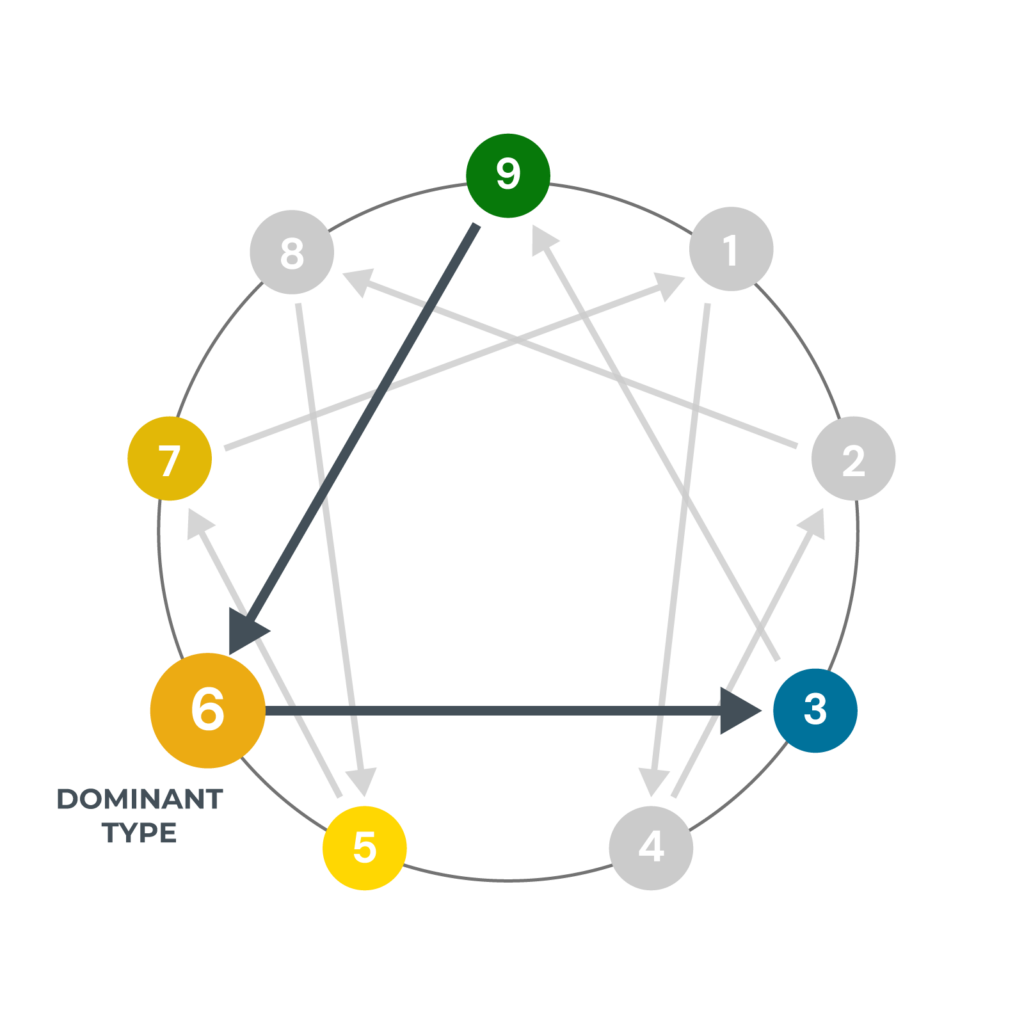
The Enneagram’s arrow lines point in the direction of each type’s specific path of psychological and spiritual growth and away from important characteristics and experiences we had to repress in childhood (but periodically return to for a sense of security). These connection points indicated by the Enneagram diagram help us see how we can aim to embody the higher aspects of these two specific points to further our inner journey: the point ahead of our core point represents key challenges we need to master to become more whole and the point behind our core type along the arrow lines represents issues from the past that we need to re-integrate such that we can reclaim what we disowned in childhood to ground and support our forward movement along the path indicated by the arrows.

Moving Back to Type 9

The path of growth for Type Sixes calls for them to reclaim their ability to relax in their connections with others and go with the flow of life without having to worry about threats in the environment or something bad happening. Sixes may not have been able to find inner support through connections with others because those others may have been threatening, punishing, unpredictable, absent, or ineffectual. Instead of being able to blend with others and find a comfortable sense of merging in relationships, Sixes usually had to move away from others in order to protect themselves from dangerous people or find safety in independence. Nines often say they trust others easily, but many Sixes did not have this luxury when they were young, and so have become stuck in mistrust and suspicion as a survival strategy.

Sixes may return to their “child–heart” point of Nine as a way of finding a sense of security through merging with something or someone safe—by taking refuge in a comfortable place or a connection with another. Sandra Maitri explains that within every Six is a lazy, Nine-ish child “who just wants to stay under the covers, doesn’t want to go out and face the world, wants only to be comfortable and entertained.”

Navigated consciously, a Six can use the “move to Nine” developmentally by establishing a healthy balance between watching out for dangers to their well-being and being able to relax in the security of supportive relationships. Sixes can focus on the attributes of this “child-heart” point to understand what they may have needed from their early relationships that they didn’t get enough of, and then seek those things out as a way of tempering the fear and mistrust they had to develop to survive.

Moving Ahead to Type 3

The Inner Flow growth path for Type Sixes bring them into direct contact with challenges embodied in Type Three: developing an ability to use goals and relationships as supports to overcome fear, take action, and achieve results. In extremely stressful situations, Sixes may defensively act out the “low side” of Threes by engaging in frantic action or anxious striving. However, by engaging the Three Point in a conscious way and seeking to embody the higher Type Three qualities of productivity, honesty, and hope, Sixes can work against the fears that hold them back.

In light of their tendencies to become paralyzed by fearfulness and overanalysis or throw themselves into nervous hard work, Sixes can use Three Point to shift their attention away from their fears and anxieties and focus instead on the worthiness of their goals, the positive aspects connected to impressing others with their good work, and sincere pride in achievement. As getting stuck in fear can, in the extreme, threaten Sixes’ well-being, it serves them to learn to use the natural motivation Threes feel toward forward movement and the accomplishment of goals to counteract their habit of getting caught up in inaction or indecisiveness.The Six working consciously in this way can make ready use of the tools healthy Type Threes use: self-confidence, an ability to manage feelings, and dedication to results.

The high side of the Three stance has its basis in honest self-expression, the enjoyment of activity in the service of making things happen in effective ways, and the hopeful expectation that they will be rewarded for their sincere efforts. These Three aspects can serve to balance out Sixes’ preoccupation with what might go wrong, which can weaken their ability to act in the world. By focusing on realizing the higher capacities associated with Type Threes—actively focusing on the drive, industriousness, hopeful outlook, and healthy desire for recognition of the Three Point—Sixes can counter their tendency to undermine themselves through insecurity, doubt, and the fear of attracting attention and becoming a target.

Type Six Subtypes

Each Enneagram type is influenced by three instinctual drives that create distinct expressions of the type:

Self-Preservation Six

Warmth

Self-Preservation Sixes express the passion of fear through a need for protection, for friendship, and for banding together with others. In seeking protective alliances, SP Sixes endeavor to be warm, friendly, and trustworthy, which is why they bear the name “Warmth.” This most “phobic” of the Sixes has difficulty expressing anger, feels uncertain, and engages in a lot of self-doubt. For SP Sixes, fear manifests as insecurity, and they focus on relationships as a way of feeling safer in the world.

Social Six

Duty

Social Sixes express fear through a need to deal with anxiety by relying on abstract reason or ideologies as a frame of reference. Obeying authority through knowing the rules helps them to feel safe in the world. Unlike the SP Six, this Six has more certainty and can be “too sure” of things as a way of dealing with the anxiety of uncertainty. Social Sixes focus on precision and efficiency. They adhere to whatever the guidelines are as a form of having a protective authority.

Sexual/One-to-One Six

Strength/Beauty

Sexual Sixes express fear by going against fear—by becoming strong and intimidating. Trusting themselves more than others, these Sixes have the inner programming that when you are afraid, the best defense is a good offense. They take on a powerful stance, both in what they do and how they look, as a way of holding the enemy at a distance. Their anxiety is allayed through skill and readiness in the face of an attack.

Continue Your Enneagram Journey

Discover more insights about Type One and explore how the Enneagram can transform your personal and professional relationships.

Get Full Report

Unlock your complete personality profile with detailed insights and growth strategies.

Team Development

Apply Enneagram insights to improve team dynamics and communication in your organization.

Coaching Sessions

Work with a certified Enneagram coach to accelerate your personal growth journey.

About the Enneagram

Enneagram Compass logo
What is the Enneagram?

Learn about how the Enneagram can help you better understand yourself and others.

3 Centers icon
Introduction to the 3 Centers

Discover the Head, Heart, and Body Centers and how they shape your core responses to the world.

Nine Types icon
Introduction to Nine Types

An overview of the nine Enneagram types and the unique traits that define each one.

3 Instincts icon
The 3 Instincts

Explore the three key instincts—Self-preservation, Social, and Sexual—and their influence on you.

27 SubTypes icon
Introduction to the 27 SubTypes

Explore the Enneagram’s 27 subtypes and how they refine the nine core types.​

Publications icon
Publications

Access books, articles, and resources from leading Enneagram experts to deepen your understanding.

Privacy Policy

We are fully compliant with the General Data Protection Regulation. Our servers are located within the EU so no data is sent outside the EU jurisdiction. Every individual has rights as to how their personal data is handled, and we recognize the need to treat all such data in an appropriate and lawful manner, according to the classification of such data. Personal data, including sensitive data, are subject to certain legal safeguards with the provisions under the GDPR and we fully comply with these legal guidelines.
 

All data (personal and otherwise) that we collect as a result of use of our Questionnaire based assessments is handled in accordance with the Privacy Policy outlined below and we can reassure you that we will not share that information for any use whatsoever other than to provide the service for which we have been contracted. This statement explains how we use the personal information that you give us. Please do not send us any personal data about anyone else without their permission.

 
Future Research and Direct Marketing Communications
 

We would like to be able to contact you in future with details of research projects we may be conducing; or in relation to further products and services that we think you may be interested in. We will only send you further emails in regards to our future research projects or marketing communications if you directly consent to us doing so- there is a specific question that asks for your consent. We will always contact you by email or other electronic means. We will treat your personal details with the utmost care and will never sell them to other companies for marketing purposes

We use MailChimp to send our email newsletters. By signing up to receive our email communications, you agree to the transfer of data to MailChimp and Active Campaign.

Updating Your Data, Erasure, and Requesting a Copy of Your Records
 

If you would like to:

  • Update your details
  • Withdraw your consent/opt out of marketing communications
  • Request erasure of the data we hold on you
  • Request a copy of the data records we hold on you (we will endeavour to fulfil the request within twenty four hours but no more than 14 days)

Please contact info@enneagramprofiling.com and we will respond within 48 hours.

Cookies

This site uses cookies – small text files that are placed on your machine to help the site provide a better user experience. In general, cookies are used to enable a client to return to the same place within a questionnaire should they be interrupted and have to discontinue the session.

Cookies can also be used to store information for things like shopping carts, and provide anonymised tracking data to third party applications like Google Analytics. As a rule, cookies will make your browsing experience better. We will send you a link to continue the questionnaire so cookies are not essential for you to enjoy our services. It may be that you may prefer to disable cookies on this site and on others. The most effective way to do this is to disable cookies in your browser. We suggest consulting the Help section of your browser or taking a look at the About Cookies website which offers guidance for all modern browsers

Data Security

At Enneagram Compass we demand the highest levels of data security. Our server provider has achieved ISO 27001 certification. We use Transport Layer Security (TLS) encryption (also known as HTTPS) for all transmitted data. Surveys can be protected with passwords and HTTP referrer checking. Our services are hosted by trusted data centres that are independently audited using the industry standard SSAE-16 method. The servers are protected by high-end firewall systems, and scans are performed regularly to ensure that any vulnerabilities are quickly found and patched.

In order to comply with GDPR we understand that data collected from the participant’s PC in Europe cannot be transferred to a server in another jurisdiction such as the US. So that we do not breach EU data protection law our server is located in Ireland. The data we collect in Europe is therefore stored and processed in Europe and is not moved to another jurisdictional area.

Disclosure – Sharing Your Data

We will not disclose your personal information to third parties except:

  • as necessary to fulfil your order(s) for our goods and services and to validate your payment details;
  • to suppliers that process data on our behalf;
  • to your coach or enneagram consultant who purchased a test on your behalf where we believe, in good faith, that it is necessary to comply with the law or to protect the safety of Enneagram Profiling, our customers or their clients, or the public.

We may use and disclose aggregated and anonymised information for marketing, product development, strategic or research purposes. In such data, no individual customer will be identifiable.

Credit Card Payments

For those using the site to purchase access to our services Stripe and PayPal are used to collect personal information related to credit card processing including . Full Name, Email Address, Billing Address, Credit Card number.

Stripe’s services in Europe are provided by a Stripe affiliate—Stripe Payments Europe Limited (“Stripe Payments Europe”)—an entity located in Ireland. In providing Stripe Services, Stripe Payments Europe transfers personal data to Stripe, Inc. in the US. To ensure the adequate protection of personal data, we have certified to the EU-U.S. and Swiss-U.S. Privacy Shield.

PayPal are still to provide their understanding of whether they are fully GDPR compliant. Their privacy policy can be read here https://www.paypal.com/uk/webapps/mpp/ua/privacy-prev . PayPal argue that they are compliant with various financial regulation laws but we suggest not using PayPal if this is something you are concerned about.

Sending Result Reports to a Third Party

Where an individual takes one of our instruments under the direction of one of our professional customers, (such as a consultant, a coach, a line manager, an Enneagram teacher etc.) and Enneagram Compass performs a service hosting, administering and scoring that instrument for the customer, then we will send the individual’s results to that customer in order that they may provide appropriate feedback, or similar service, to the individual who took the instrument. By taking the questionnaire you are giving permission for that Third Party to receive a copy of your report. In completing the questionnaire you are agreeing for the report to be sent to such a third party. We at Enneagram Profiling assume that the data will be used for the sole purpose of aiding your understanding of the Report, and in order for you to derive maximum benefit from the process. However, we do not accept any responsibility whatsoever for the actions of our third-party customers who have ordered the questionnaire and results report on your behalf. Enneagram Profiling is therefore not responsible for the use, storage or distribution of such data, or the consequences thereof that may arise as a result of the use of the report.

Retention Period – Anonymisation

Links to Other Sites