





Overview

Type Seven represents the archetype of the person who seeks pleasure in different forms as a distraction from the discomfort, darkness, and downside of life. This archetype’s drive is to defend against the experience of pain using intelligence, imagination, charm, and enthusiasm, and to avoid fear through an optimistic outlook.

The Jungian concept of the “puer” or the “divine child” is another form of this archetype. It represents a “symbol for future hopes…the potentiality of life, newness itself… frivolity, pleasure, and play.” Jung characterizes this archetype as the “Eternal Child,” who resists growing up as a way of trying to avoid taking on responsibility, along with its commitments, encumbrances, and difficulties.

This archetypal character predominantly focuses on the lighter sides of life, the “enlivening, charming, and refreshing elements of human experience,” avoiding the darker Shadow aspects of human experience. The Type Seven personality and the puer archetype embody a highly positive idealism, a youthful enthusiasm, and a focus on future hopes. This archetype’s dark side reflects the opposite of these qualities in its unconscious unwillingness to face the pain of separation, aging, and mortality.

Pain is part of what motivates the desire for personal development, and conscious suffering represents a key part of the growth process. Most people decide to do the difficult work of the “inner journey” in order to ease their suffering and find happiness. We must necessarily face our fears and childhood pain in the course of this journey, like an acorn has to go underground and have its shell crack open. For any of us to become all that we can be—expand into the “oak tree” of our higher Self—we have to find the courage to see wisdom and truth in the darkness as well as the light. To truly develop, we must face our fears and our Shadow parts. This hard truth is what the Seven’s path of growth teaches us.

As with all the archetypal personalities, however, Type Sevens’ gifts and strengths also represent their “fatal flaw” or “Achilles heel,” as their talent for reframing “negatives” into “positives” can cause them to ignore important data that doesn’t fit their positive frame. Although they are fun and enjoyable companions, Sevens have difficulty in relationships when called on to confront problems and deal with the pain or discomfort of conflict. And while they excel at brainstorming, their dislike of the routine and mundane aspects of life can lead them to be avoidant, distracted, irresponsible, and noncommittal in long-term projects.

Focus of Attention

Type Sevens avoid unpleasant feelings by focusing on what feels pleasant and by keeping the mood upbeat to the point of reframing negatives into positives.

A fear of being trapped in discomfort fuels quick thinking, creative problem-solving, and a focus on positive future possibilities.

Thoughts and Emotions

Thoughts and Emotions

Type Sevens have quick, synthesizing minds, with which they find links between the commonalities in different subjects, making rapid mental associations. Emotionally, Sevens like feeling happy or joyful emotions and dislike feeling fear, anxiety, sadness, boredom, pain, or discomfort. Their attitude is, “Why feel pain if you can feel happy instead?”

Behaviour Patterns

Sevens are energetic, fast-paced, innovative, and active. They usually have many interests and activities, which they pursue with enthusiasm. Sevens like planning for fun and maintaining many options, so they can keep their mood up and shift to the most pleasant option if one plan becomes undesirable or untenable

Blind Spots

Common Blind Spots
When Blind Spots Are Integrated

The Passion is Gluttony

Gluttony

Gluttony is the passion that drives Type Seven. In its expression as the core emotional motivation of this type, gluttony fuels the desire to experience pleasure without limits, to taste a little bit of every experience, and to stay open to myriad possibilities. Gluttony can be understood as a passion for variety, not just over-indulgence in food and drink. It motivates this type to want to experience all the possibilities in life and avoid any constraints that might force them to experience less. They put a lot of effort into guaranteeing that they can indulge in many different kinds of pleasures and satisfy their immediate desires, including those connected to the mind. They usually have very busy, quick, and active minds that constantly and rapidly come up with new ideas and make plans in imaginative ways.

The Virtue is Sobriety

Sobriety

Sobriety is the virtue that provides an antidote to Type Seven gluttony. Sobriety opposes gluttony as the heart’s capacity to feel a deep sense of satisfaction in focusing on one important thing at a time. Sobriety helps this type appreciate sticking with an experience all the way through to the end. In this context, it means reducing excess movement and coming to stillness. In sobriety, this type becomes more committed to things and people and rejects their exaggerated need for mental stimulation and distractions. They feel more serious and less relentlessly happy—but still happy enough. Sobriety offers this type a clear goal to work toward after consciously observing their gluttony and the patterns that flow from it.

Discover Your Full Personality Profile

Get a comprehensive analysis of your type, including personalized growth strategies and relationship insights.

Growth Path

As Sevens work on themselves and become more self-aware, they learn to escape the trap of pursuing more superficial pleasures and avoiding the enjoyment of a deeper experience of themselves. They do this by slowing down and allowing themselves to be present, appreciating the value of their fear and their pain, and finding the joy in personal connections that comes when they connect with their own depths.

For Sevens, growth involves observing the ways they avoid the deeper parts of themselves (and life) to stay comfortable; exploring the ways they lose contact with themselves when they defend against pain and seek out pleasure; and making active efforts to reconnect with themselves and reengage with life on a deeper and more immediate level. It is particularly important for them to learn to endure the pain involved in inner work with the understanding that true joy, contentment, and aliveness come from facing what we tend to run away from and integrating what scares us.

Wings and Arrows

In using the Enneagram to further growth, as it is intended, the first steps involve observing yourself to make the patterns and habits associated with your main, or “core,” type more conscious.

After you have done this for a while, you can create further growth shifts by using the wings and arrows as pathways for growth.

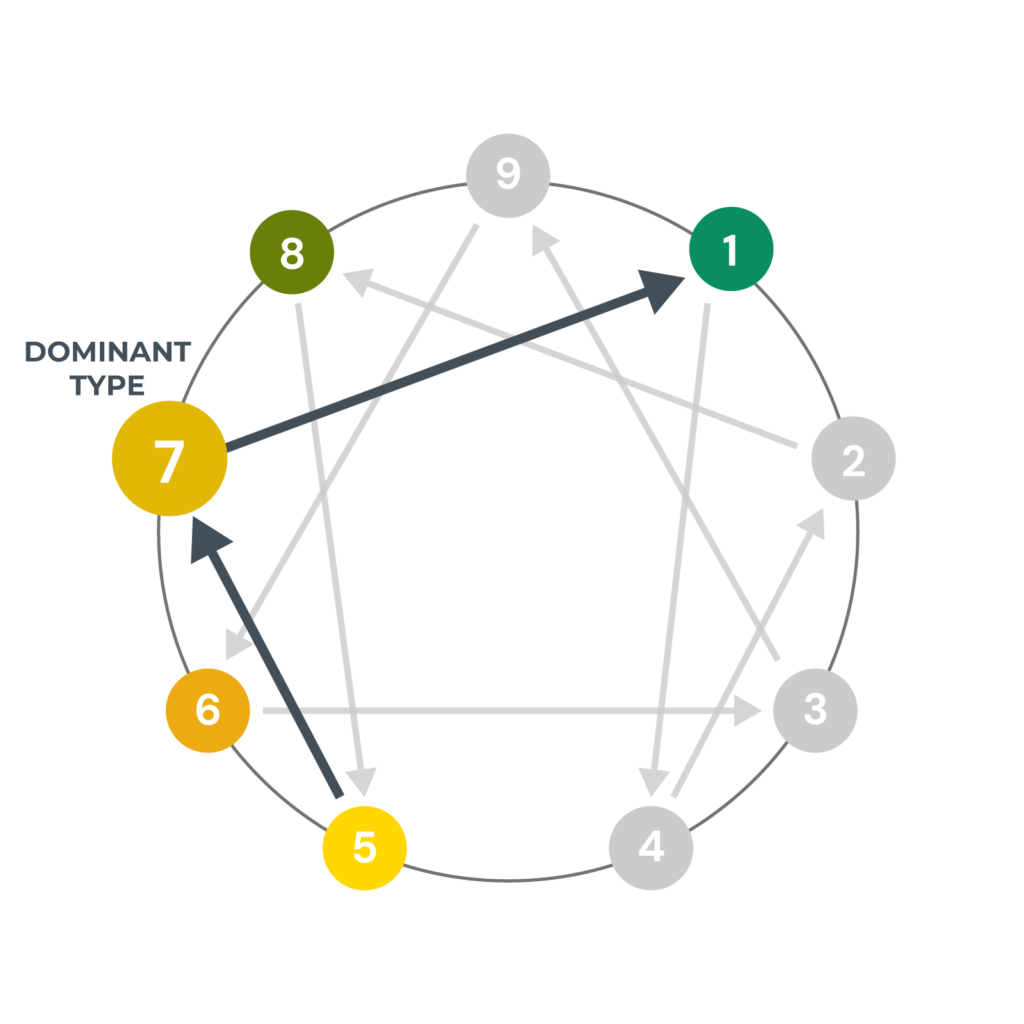
The Enneagram’s arrow lines point in the direction of each type’s specific path of psychological and spiritual growth and away from important characteristics and experiences we had to repress in childhood (but periodically return to for a sense of security). These connection points indicated by the Enneagram diagram help us see how we can aim to embody the higher aspects of these two specific points to further our inner journey: the point ahead of our core point represents key challenges we need to master to become more whole and the point behind our core type along the arrow lines represents issues from the past that we need to re-integrate such that we can reclaim what we disowned in childhood to ground and support our forward movement along the path indicated by the arrows.

Moving Back to Type 5

The path of growth for Type Sevens calls for them to reclaim healthy restraint and the ability to withdraw and reflect that is characteristic of Type Five. Sevens may have had the experience in childhood that their need to retreat to a private space as a way of avoiding fear wasn’t okay. They may have felt like their natural sense of fear and the associated desire to retreat was unacceptable, so they became more active in managing the outside world through charm to disarm the limiting potential of outside authorities. For one reason or another, it may not have been safe or desirable for Sevens to show their fear or express their need to hold on to precious resources. Sevens may thus “go to Five” under conditions of stress or security as a resource point to which they can withdraw to find a safe place to rest or to consolidate their position and generate internal support. The move to Five can thus represent a desire to be less social and less “out there”—to be more boundaried and safely removed from the social whirl.

For these reasons, “moving back to Five” can be a way that Sevens retreat from others and moderate their need to be excessively social. Consciously drawing on the high side of the Five Point can help them find a healthy way to be more internal and more involved in their thoughts in a less manic way. But because the Five point represents a natural part of Sevens that they had to repress in childhood and thus may return to compulsively, Sevens risk getting stuck in the back-and-forth between the overly optimistic, excessively enthusiastic gregariousness of the Seven and the total withdrawal of the Five.

When Sevens return to the Five Point in an anxious or unconscious way, it’s likely that Sevens are not so much reclaiming a healthy sense of privacy and inner calm as they are temporarily shutting down as an escape from overcommitment and excessive activity. In addition, as Sandra Maitri suggests, the usually happy-go-lucky Seven experiences the move to Five as a childish sense of inner scarcity motivated by the fear of loss and inner emptiness.

Moving Ahead to Type 1

The Inner Flow growth path for Type Sevens brings them into direct contact with the challenges embodied in Type One: allowing for a clearer perception of what is ideal and “right” in a larger sense as a way of stabilizing a focus on taking action in service of a higher good. Not surprisingly, Sevens can find the anxiety and frustration they might feel as they move to One (and potentially become perfectionistic or self-critical) uncomfortable. But an experience of Type One managed mindfully, can help Sevens move out of their dreams and fantasies, and into a more realistic acceptance of standards and limits.

When done unconsciously, this shift may involve an anxious resistance or adherence to the constraints imposed by rules and routines; but when done more consciously, it can open Sevens up to the possibility of a supportive structure based on standards and precision that can help Sevens actualize their ideals. Instead of getting caught up in living for an imagined or idealized future, Sevens can find ways to accept the specific constraints that will allow them to put their plans into action in more pragmatic ways in the present. Sevens can thus be inspired by the high side of the One Point in ways that both help them express their impulse toward creative invention and ground what they actually do in larger notions of the “good” or the “perfect.”

Sevens’ focus on planning and play can, in the extreme, prevent them from moving forward in serious and disciplined ways; moving to One can help Sevens make the possibilities they imagine more practical, achievable, and polished.

Type Seven Subtypes

Each Enneagram type is influenced by three instinctual drives that create distinct expressions of the type:

Self-Preservation Seven

Keepers of the Castle

The Self-Preservation Seven expresses gluttony through making alliances and creating opportunities for gaining an advantage. Pragmatic and self-interested, these Sevens find safety through networking and being alert to opportunities that support their survival. The name “Keepers of the Castle” refers to their way of establishing a partisan network of allies through which they create safety and satisfy their needs. Cheerful and amiable, they have a love of pleasure and tend to get what they want.

Social Seven

Sacrifice

As the countertype, Social Sevens go against gluttony through conscientious efforts to be of service to others. Conscious of wanting to avoid exploiting others, they have a need to be good and pure and to sacrifice their own needs in supporting the needs of others. They have a passion for being seen as good for the sacrifice of their own desires. They express an ascetic ideal and make a virtue of getting by on little. They express idealism and enthusiasm as a way of making themselves feel active and valued in the world.

Sexual/One-to-One Seven

Suggestibility

Sexual Sevens express gluttony through a need to imagine something better than ordinary reality. Gluttons for things of a higher world, they are idealistic dreamers with a passion for living in their imaginations. Sexual Sevens look at things with the optimism of someone who is in love; they see the world through rose-colored glasses. “Suggestibility” refers to being somewhat naive and easy to hypnotize. Light-hearted and enthusiastic, they focus on exciting possibilities and pleasurable fantasies, and they believe they can do everything.

Continue Your Enneagram Journey

Discover more insights about Type One and explore how the Enneagram can transform your personal and professional relationships.

Get Full Report

Unlock your complete personality profile with detailed insights and growth strategies.

Team Development

Apply Enneagram insights to improve team dynamics and communication in your organization.

Coaching Sessions

Work with a certified Enneagram coach to accelerate your personal growth journey.

About the Enneagram

Enneagram Compass logo
What is the Enneagram?

Learn about how the Enneagram can help you better understand yourself and others.

3 Centers icon
Introduction to the 3 Centers

Discover the Head, Heart, and Body Centers and how they shape your core responses to the world.

Nine Types icon
Introduction to Nine Types

An overview of the nine Enneagram types and the unique traits that define each one.

3 Instincts icon
The 3 Instincts

Explore the three key instincts—Self-preservation, Social, and Sexual—and their influence on you.

27 SubTypes icon
Introduction to the 27 SubTypes

Explore the Enneagram’s 27 subtypes and how they refine the nine core types.​

Publications icon
Publications

Access books, articles, and resources from leading Enneagram experts to deepen your understanding.

Privacy Policy

We are fully compliant with the General Data Protection Regulation. Our servers are located within the EU so no data is sent outside the EU jurisdiction. Every individual has rights as to how their personal data is handled, and we recognize the need to treat all such data in an appropriate and lawful manner, according to the classification of such data. Personal data, including sensitive data, are subject to certain legal safeguards with the provisions under the GDPR and we fully comply with these legal guidelines.
 

All data (personal and otherwise) that we collect as a result of use of our Questionnaire based assessments is handled in accordance with the Privacy Policy outlined below and we can reassure you that we will not share that information for any use whatsoever other than to provide the service for which we have been contracted. This statement explains how we use the personal information that you give us. Please do not send us any personal data about anyone else without their permission.

 
Future Research and Direct Marketing Communications
 

We would like to be able to contact you in future with details of research projects we may be conducing; or in relation to further products and services that we think you may be interested in. We will only send you further emails in regards to our future research projects or marketing communications if you directly consent to us doing so- there is a specific question that asks for your consent. We will always contact you by email or other electronic means. We will treat your personal details with the utmost care and will never sell them to other companies for marketing purposes

We use MailChimp to send our email newsletters. By signing up to receive our email communications, you agree to the transfer of data to MailChimp and Active Campaign.

Updating Your Data, Erasure, and Requesting a Copy of Your Records
 

If you would like to:

  • Update your details
  • Withdraw your consent/opt out of marketing communications
  • Request erasure of the data we hold on you
  • Request a copy of the data records we hold on you (we will endeavour to fulfil the request within twenty four hours but no more than 14 days)

Please contact info@enneagramprofiling.com and we will respond within 48 hours.

Cookies

This site uses cookies – small text files that are placed on your machine to help the site provide a better user experience. In general, cookies are used to enable a client to return to the same place within a questionnaire should they be interrupted and have to discontinue the session.

Cookies can also be used to store information for things like shopping carts, and provide anonymised tracking data to third party applications like Google Analytics. As a rule, cookies will make your browsing experience better. We will send you a link to continue the questionnaire so cookies are not essential for you to enjoy our services. It may be that you may prefer to disable cookies on this site and on others. The most effective way to do this is to disable cookies in your browser. We suggest consulting the Help section of your browser or taking a look at the About Cookies website which offers guidance for all modern browsers

Data Security

At Enneagram Compass we demand the highest levels of data security. Our server provider has achieved ISO 27001 certification. We use Transport Layer Security (TLS) encryption (also known as HTTPS) for all transmitted data. Surveys can be protected with passwords and HTTP referrer checking. Our services are hosted by trusted data centres that are independently audited using the industry standard SSAE-16 method. The servers are protected by high-end firewall systems, and scans are performed regularly to ensure that any vulnerabilities are quickly found and patched.

In order to comply with GDPR we understand that data collected from the participant’s PC in Europe cannot be transferred to a server in another jurisdiction such as the US. So that we do not breach EU data protection law our server is located in Ireland. The data we collect in Europe is therefore stored and processed in Europe and is not moved to another jurisdictional area.

Disclosure – Sharing Your Data

We will not disclose your personal information to third parties except:

  • as necessary to fulfil your order(s) for our goods and services and to validate your payment details;
  • to suppliers that process data on our behalf;
  • to your coach or enneagram consultant who purchased a test on your behalf where we believe, in good faith, that it is necessary to comply with the law or to protect the safety of Enneagram Profiling, our customers or their clients, or the public.

We may use and disclose aggregated and anonymised information for marketing, product development, strategic or research purposes. In such data, no individual customer will be identifiable.

Credit Card Payments

For those using the site to purchase access to our services Stripe and PayPal are used to collect personal information related to credit card processing including . Full Name, Email Address, Billing Address, Credit Card number.

Stripe’s services in Europe are provided by a Stripe affiliate—Stripe Payments Europe Limited (“Stripe Payments Europe”)—an entity located in Ireland. In providing Stripe Services, Stripe Payments Europe transfers personal data to Stripe, Inc. in the US. To ensure the adequate protection of personal data, we have certified to the EU-U.S. and Swiss-U.S. Privacy Shield.

PayPal are still to provide their understanding of whether they are fully GDPR compliant. Their privacy policy can be read here https://www.paypal.com/uk/webapps/mpp/ua/privacy-prev . PayPal argue that they are compliant with various financial regulation laws but we suggest not using PayPal if this is something you are concerned about.

Sending Result Reports to a Third Party

Where an individual takes one of our instruments under the direction of one of our professional customers, (such as a consultant, a coach, a line manager, an Enneagram teacher etc.) and Enneagram Compass performs a service hosting, administering and scoring that instrument for the customer, then we will send the individual’s results to that customer in order that they may provide appropriate feedback, or similar service, to the individual who took the instrument. By taking the questionnaire you are giving permission for that Third Party to receive a copy of your report. In completing the questionnaire you are agreeing for the report to be sent to such a third party. We at Enneagram Profiling assume that the data will be used for the sole purpose of aiding your understanding of the Report, and in order for you to derive maximum benefit from the process. However, we do not accept any responsibility whatsoever for the actions of our third-party customers who have ordered the questionnaire and results report on your behalf. Enneagram Profiling is therefore not responsible for the use, storage or distribution of such data, or the consequences thereof that may arise as a result of the use of the report.

Retention Period – Anonymisation

Links to Other Sites