





Overview

Type Four represents the archetype of the person who experiences an inner sense of lack and a craving for that which is missing, and yet can’t allow for the attainment of what might provide satisfaction. This archetype’s drive is to focus on what is lacking as a step to regaining wholeness and connection but through an over-focus on the experience of a flawed self, they become convinced of an inner deficiency that prevents fulfillment. While this entails an understandable frustration with regard to deprivation, an overidentification with the frustrated, deprived state leads to an inability to take in that which would provide fulfillment.

Type Fours overidentify with those parts of ourselves we’d rather others don’t see. Although Fours may also recast their sense of deficiency as being “special” or “unique” as a way of valuing themselves on a surface level, they identify with a deficient self more than an idealized self. Type Fours are thus the prototype for that part in all of us that feels dissatisfied with who we are. We all have the capacity to feel bad about what we see as our flaws and to grieve and long for what we see as lacking in our lives. We can all become depressed in the face of feeling inadequate when we don’t fit the idealized image of what we believe we have to be to get the love we want. This archetype thus represents the tendency we all have to develop an “inferiority complex,” which makes it difficult to feel good about ourselves and take in what is good from the outside.

The natural strengths of Type Fours include their large capacity for emotional sensitivity and depth, their ability to sense what is going on between people on the emotional level, their natural feel for aesthetics and creativity, and their idealistic and romantic sensibility. Relatively unafraid of intense feelings, Fours value the expression of authentic emotion and can support others with great care, respect, and sensitivity when they are experiencing painful emotions. Fours are highly empathic and can see the beauty and power in painful feelings that other types habitually avoid.

Fours’ “superpower” is that they are naturally emotionally intuitive. Fours’ regular contact with their own emotional terrain gives them a lot of comfort and strength in being with intense feelings and empowering others to feel and accept their emotions. Although it would be wrong to think that all Fours are artists or all artists are Fours, they do have an artistic impulse that enables them to see and respond to the poetry in life, and to highlight for others the way everyday experiences can be viewed and communicated in creative and even transcendent ways.

As with all the archetypal personalities, however, Type Fours’ gifts and strengths also represent their “fatal flaw” or “Achilles heel:” they can overdo their focus on pain and suffering, sometimes as a way of avoiding a deeper or different kind of pain. While they have a gift for emotional sensitivity, they can become attached to their feelings in a way that can prevent them from thinking objectively or taking action. They can see what’s missing so clearly that they may be blind to what is good or hopeful in a situation, often to their own detriment. However, when they can wake up to the ways in which they dwell in suffering or dramatize their emotions as a way of distracting themselves from their deeper need for love, they can express a special kind of wisdom that is informed by deep emotional truth.

Focus of Attention

Fours focus attention on their own feelings, the feelings of others, and interpersonal connection and disconnection.

They feel a sense of deficiency about their own worth, so they seek idealized experiences of qualities they perceive as outside themselves.

Thoughts and Emotions

Thoughts and Emotions

Fours value authentic expressions of a wide range of emotions. Their thought patterns center on what is missing in a given situation and on longing for whatever they perceive as ideal and somehow unavailable. They appreciate meaningful interactions rooted in real feelings and have a keen aesthetic sensibility based on the translation of emotional experience into artistic expression, but they tend to overidentify with feelings and dwell in melancholy (or anger).

Behaviour Patterns

Fours can be reserved and withdrawn, or energetic and active, or both. They are emotionally intuitive, empathic, and intense. While specific behavior patterns vary according to subtype, Fours generally aren’t afraid of conflict, will work tirelessly when they feel passionately connected to something, and can see what’s missing and speak to it.

Blind Spots

Common Blind Spots
When Blind Spots Are Integrated

The Passion is Envy

Envy

Envy manifests as a painful sense of lack and a craving toward that which is felt lacking. For Fours, Envy grows out of an early sense of loss that leads to a perception that something good is outside the Four’s experience—and that this something is necessary but missing because of an inner deficiency.

The Virtue is Equanimity

Equanimity

Equanimity, understood as a state of emotional balance that allows you to rise above the ups and downs of emotional experience and see equal value in all people, feelings, and situations, helps this type grow beyond their need to feel extraordinary to have value.

Discover Your Full Personality Profile

Get a comprehensive analysis of your type, including personalized growth strategies and relationship insights.

Growth Path

For Type Fours, the key to embracing their true selves lies in gradually shifting their focus from what they view as negative or missing and allowing themselves to see what’s positive and present. For many people, this is difficult, as the ego tells us we are not enough, or we need to be more, or we aren’t perfect enough, or we don’t meet some arbitrary standard. But this type can only rise above their self-defeating habit of trying to escape to an idealized past or future by becoming conscious of their personality patterns and the ways they stay stuck in them. In fact, the only moment any of us can experience is the present. By being more present, 4s develop the ability to access their true selves and learn that all is well as it is.

When Type Fours courageously give up their defensive stance of proactively rejecting themselves in order to protect themselves from abandonment, they begin to integrate their “positive Shadow.” They own their true goodness and accept themselves as they are. This leads them from a flawed sense of self to a realization that their inadequacy is an illusion—a strangely safe illusion, but a fantasy based on the fear of being hurt again. As they progress on their path, they come to embrace their own essential wholeness—and they become uniquely gifted in supporting others on that same journey from envy to equanimity.

Wings and Arrows

In using the Enneagram to further growth, as it is intended, the first steps involve observing yourself to make the patterns and habits associated with your main, or “core,” type more conscious.

After you have done this for a while, you can create further growth shifts by using the wings and arrows as pathways for growth.

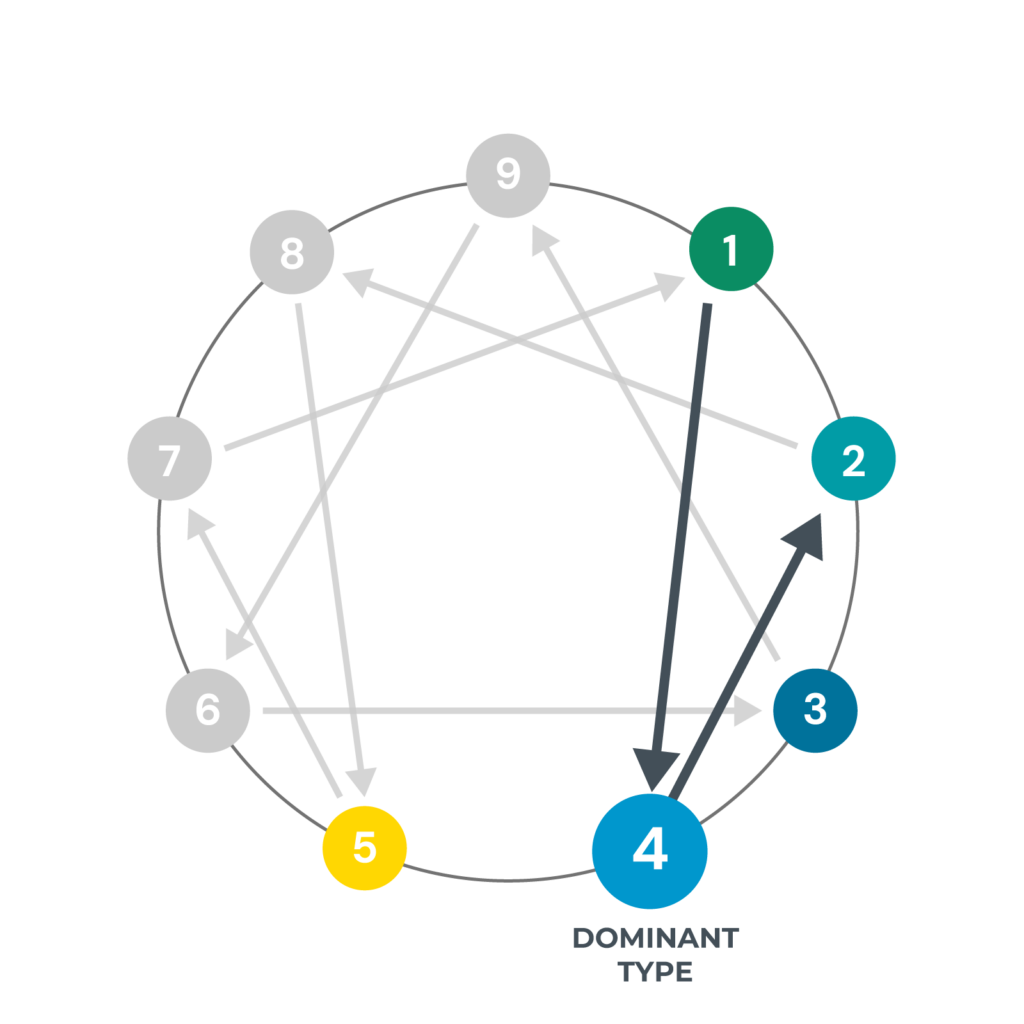
The Enneagram’s arrow lines point in the direction of each type’s specific path of psychological and spiritual growth and away from important characteristics and experiences we had to repress in childhood (but periodically return to for a sense of security). These connection points indicated by the Enneagram diagram help us see how we can aim to embody the higher aspects of these two specific points to further our inner journey: the point ahead of our core point represents key challenges we need to master to become more whole and the point behind our core type along the arrow lines represents issues from the past that we need to re-integrate such that we can reclaim what we disowned in childhood to ground and support our forward movement along the path indicated by the arrows.

Moving Back to Type 1

The path of growth for Type Fours calls for them to reclaim their ability to use self-evaluation, self-discipline, and structure as ways to support themselves rather than as ways of devaluing and punishing themselves. As children, Fours may have had to downplay their natural ability to use their ideals and follow the rules as a way of taking action to feel good about themselves and be productive in the world. In response to early loss or deprivation, Fours more typically took refuge in a flawed self-image and an experience of longing for what might have been, which can pull their focus away from working hard to prove their worth. The strategy of trying to be good as a way of earning approval may not have worked if they had to cope with an overwhelming sense of loss or deep feelings of deficiency.

Fours tend to cope by attaching to a feeling of hopelessness or melancholy, to avoid being hopeful about things they believe might not happen. In doing this, they may have had to give up One attributes such as the active capacity to enact practical ideals and a belief in their ability to control what happens through hard work. They may not have been able to provide structure for themselves through routine and adherence to standards and rules because they had to focus on coping with a specific experience of loss or deprivation.

Fours can consciously draw on the strengths of the One Point, using them to gain the support they need in their growth toward the Two Point, by taking action to manifest their ideals. Being more perfectionistic—not by controlling or stirring emotions, but by actively improving themselves or their environment—can give Fours a sense of control and accomplishment.

Regular patterns and repetitive work can help a Four find peace and containment amidst a life in which they can get lost in the ups and downs of their shifting moods. By reincorporating their ability to work hard in support of improving themselves or others, Fours can take action and feel more powerful and confident, which can support their growth and development instead of holding them back in a search for something they lost in the past.

Moving Ahead to Type 2

The Inner Flow growth path for Type Fours brings them into direct contact with the challenges embodied in Type Two: allowing for a balance between self-referencing and other-referencing, between meeting your own needs and meeting the needs of others, and between being your authentic self and adapting to other people. Under stress, Fours can get defensive when pressed toward the Two Point and act out the lower side of Two by giving compulsively in an effort to be liked, or giving up what they need in an attempt to buy others’ love or acceptance. But when Fours can consciously manage the challenges embodied in the Two “stress–growth” opportunity, they can use the high side Two qualities to bring themselves out of their self-absorption, intense feelings, and isolation, find creative ways to express who they really, are and open themselves up to connecting with others.

The Four working consciously in this way can make ready use of the tools that healthy Type Twos use: a sensitivity to the needs and preferences of others, a positive view of what’s possible in relationship, and the conscious management of feelings and needs in light of the feelings and needs of others.

The Two stance of adapting to please others can help Fours learn to be more adaptable and supportive of others in a way that also enlarges their view of their own worth and value to others. Fours can get lost in their own interior emotional worlds, but they can temper this tendency in service of their growth by reaching out more to nurture others. Finding ways to provide support and understanding to other people can be a good way for Fours to balance out their over-focus on their inner experience of lack or on a particular mood or emotional reaction. Consciously embodying an attitude of service to others can highlight Fours’ qualities of optimism, generosity, and cheerfulness—attributes that they might not always see and value in themselves. Through consciously balancing self-referencing with other-referencing, and the ability to dwell in darker feelings with the ability to be light, Fours can use the Two Point as a way to embody a more full and more whole sense of who they really are, and work against the self-deprecating tendency.

Type Four Subtypes

Each Enneagram type is influenced by three instinctual drives that create distinct expressions of the type:

Self-Preservation Four

Tenacity

The Self-Preservation Four is long-suffering. As the countertype of the Fours, SP Fours are stoic in the face of their inner pain and they don’t share it with others as much as the other two Fours. This is a person who learns to tolerate pain and to do without as a way of earning love. Instead of dwelling in envy, SP Fours act out their envy by working hard to get what others have and they lack. More masochistic than melodramatic, these Fours demand a lot of themselves, have a strong need to endure, and have a passion for effort.

Social Four

Shame

The Social Four suffers more, feels more shame, and is more sensitive than the other two Fours. Envy fuels a focus on shame and suffering as they employ a strategy of seducing others into meeting their needs through an intensification of pain and suffering. They experience a sense of comfort in feeling melancholy. Envy also manifests in lamenting too much, taking on the victim role, and focusing on a sense of their own inferiority. Social Fours don’t compete with others as much as they compare themselves to others and find themselves lacking.

Sexual/One-to-One Four

Competition

Sexual Fours make others suffer as an unconscious way of trying to rid themselves of painful feelings of deficiency. In denying their suffering and being more shameless than shameful, they express their needs more and can be demanding of others. In seeking to be the best, they express envy in its manifestation as competition. They express “an envy that wants,” unconsciously turning their pain at inner lack into feelings of anger about not getting what they need from others.

Continue Your Enneagram Journey

Discover more insights about Type One and explore how the Enneagram can transform your personal and professional relationships.

Get Full Report

Unlock your complete personality profile with detailed insights and growth strategies.

Team Development

Apply Enneagram insights to improve team dynamics and communication in your organization.

Coaching Sessions

Work with a certified Enneagram coach to accelerate your personal growth journey.

About the Enneagram

Enneagram Compass logo
What is the Enneagram?

Learn about how the Enneagram can help you better understand yourself and others.

3 Centers icon
Introduction to the 3 Centers

Discover the Head, Heart, and Body Centers and how they shape your core responses to the world.

Nine Types icon
Introduction to Nine Types

An overview of the nine Enneagram types and the unique traits that define each one.

3 Instincts icon
The 3 Instincts

Explore the three key instincts—Self-preservation, Social, and Sexual—and their influence on you.

27 SubTypes icon
Introduction to the 27 SubTypes

Explore the Enneagram’s 27 subtypes and how they refine the nine core types.​

Publications icon
Publications

Access books, articles, and resources from leading Enneagram experts to deepen your understanding.

Privacy Policy

We are fully compliant with the General Data Protection Regulation. Our servers are located within the EU so no data is sent outside the EU jurisdiction. Every individual has rights as to how their personal data is handled, and we recognize the need to treat all such data in an appropriate and lawful manner, according to the classification of such data. Personal data, including sensitive data, are subject to certain legal safeguards with the provisions under the GDPR and we fully comply with these legal guidelines.
 

All data (personal and otherwise) that we collect as a result of use of our Questionnaire based assessments is handled in accordance with the Privacy Policy outlined below and we can reassure you that we will not share that information for any use whatsoever other than to provide the service for which we have been contracted. This statement explains how we use the personal information that you give us. Please do not send us any personal data about anyone else without their permission.

 
Future Research and Direct Marketing Communications
 

We would like to be able to contact you in future with details of research projects we may be conducing; or in relation to further products and services that we think you may be interested in. We will only send you further emails in regards to our future research projects or marketing communications if you directly consent to us doing so- there is a specific question that asks for your consent. We will always contact you by email or other electronic means. We will treat your personal details with the utmost care and will never sell them to other companies for marketing purposes

We use MailChimp to send our email newsletters. By signing up to receive our email communications, you agree to the transfer of data to MailChimp and Active Campaign.

Updating Your Data, Erasure, and Requesting a Copy of Your Records
 

If you would like to:

  • Update your details
  • Withdraw your consent/opt out of marketing communications
  • Request erasure of the data we hold on you
  • Request a copy of the data records we hold on you (we will endeavour to fulfil the request within twenty four hours but no more than 14 days)

Please contact info@enneagramprofiling.com and we will respond within 48 hours.

Cookies

This site uses cookies – small text files that are placed on your machine to help the site provide a better user experience. In general, cookies are used to enable a client to return to the same place within a questionnaire should they be interrupted and have to discontinue the session.

Cookies can also be used to store information for things like shopping carts, and provide anonymised tracking data to third party applications like Google Analytics. As a rule, cookies will make your browsing experience better. We will send you a link to continue the questionnaire so cookies are not essential for you to enjoy our services. It may be that you may prefer to disable cookies on this site and on others. The most effective way to do this is to disable cookies in your browser. We suggest consulting the Help section of your browser or taking a look at the About Cookies website which offers guidance for all modern browsers

Data Security

At Enneagram Compass we demand the highest levels of data security. Our server provider has achieved ISO 27001 certification. We use Transport Layer Security (TLS) encryption (also known as HTTPS) for all transmitted data. Surveys can be protected with passwords and HTTP referrer checking. Our services are hosted by trusted data centres that are independently audited using the industry standard SSAE-16 method. The servers are protected by high-end firewall systems, and scans are performed regularly to ensure that any vulnerabilities are quickly found and patched.

In order to comply with GDPR we understand that data collected from the participant’s PC in Europe cannot be transferred to a server in another jurisdiction such as the US. So that we do not breach EU data protection law our server is located in Ireland. The data we collect in Europe is therefore stored and processed in Europe and is not moved to another jurisdictional area.

Disclosure – Sharing Your Data

We will not disclose your personal information to third parties except:

  • as necessary to fulfil your order(s) for our goods and services and to validate your payment details;
  • to suppliers that process data on our behalf;
  • to your coach or enneagram consultant who purchased a test on your behalf where we believe, in good faith, that it is necessary to comply with the law or to protect the safety of Enneagram Profiling, our customers or their clients, or the public.

We may use and disclose aggregated and anonymised information for marketing, product development, strategic or research purposes. In such data, no individual customer will be identifiable.

Credit Card Payments

For those using the site to purchase access to our services Stripe and PayPal are used to collect personal information related to credit card processing including . Full Name, Email Address, Billing Address, Credit Card number.

Stripe’s services in Europe are provided by a Stripe affiliate—Stripe Payments Europe Limited (“Stripe Payments Europe”)—an entity located in Ireland. In providing Stripe Services, Stripe Payments Europe transfers personal data to Stripe, Inc. in the US. To ensure the adequate protection of personal data, we have certified to the EU-U.S. and Swiss-U.S. Privacy Shield.

PayPal are still to provide their understanding of whether they are fully GDPR compliant. Their privacy policy can be read here https://www.paypal.com/uk/webapps/mpp/ua/privacy-prev . PayPal argue that they are compliant with various financial regulation laws but we suggest not using PayPal if this is something you are concerned about.

Sending Result Reports to a Third Party

Where an individual takes one of our instruments under the direction of one of our professional customers, (such as a consultant, a coach, a line manager, an Enneagram teacher etc.) and Enneagram Compass performs a service hosting, administering and scoring that instrument for the customer, then we will send the individual’s results to that customer in order that they may provide appropriate feedback, or similar service, to the individual who took the instrument. By taking the questionnaire you are giving permission for that Third Party to receive a copy of your report. In completing the questionnaire you are agreeing for the report to be sent to such a third party. We at Enneagram Profiling assume that the data will be used for the sole purpose of aiding your understanding of the Report, and in order for you to derive maximum benefit from the process. However, we do not accept any responsibility whatsoever for the actions of our third-party customers who have ordered the questionnaire and results report on your behalf. Enneagram Profiling is therefore not responsible for the use, storage or distribution of such data, or the consequences thereof that may arise as a result of the use of the report.

Retention Period – Anonymisation

Links to Other Sites