






Overview

Type Five represents the archetype of the person who withdraws into thinking and detaches from feeling as a way of taking refuge in the inner world. This functions as a way of finding privacy and freedom in a world that seems intrusive or neglectful or overwhelming. The central drive of this archetype is to find security by minimizing needs and using resources economically so that external demands can be limited and controlled. In Fives, the natural human need for people can be displaced into a thirst for knowledge, such that internal support comes through information and firm boundaries instead of social connections.

Type Fives are the prototype for that tendency in all of us to see ourselves as separate and disconnected from everything else, which causes us to feel the need to withdraw and hold on to whatever we have to survive. We all identify with our egos, and so can believe that we are isolated individuals rather than part of an interconnected whole, which leads us to become attached to the things we think we need to sustain ourselves.

In everyday life, this universal archetype may manifest in the need to have time alone to rest, or “recharge,” away from the prying eyes and emotional needs of others. It represents that part of us that would rather observe than participate and likes to withdraw periodically to a place of refuge. The Five archetype represents the model for preferring the relative safety of the intellect to the rigors of social and emotional life and sees knowledge as the most secure and satisfying form of power. In the face of conflict, difficulty, or hurt feelings, this stance sees withdrawal and distance as the best strategy.

Fives have analytical minds and tend to spend a lot of time pursuing their intellectual interests. They often possess a great deal of knowledge and expertise in particular areas of study. Because they automatically detach from emotions, they are highly skilled at performing rational, objective analyses of issues or situations. This habit also makes them calm in a crisis. As they appreciate the importance of boundaries in relationships, they value and respect others’ boundaries. While they typically don’t have a large quantity of close friends, they make high-quality, loyal, and trustworthy friends to the people with whom they do form relationships. Naturally austere and laconic, Fives are minimalistic and economical in the things they do, which reflects their concern with making the most of what resources they have and an ability to get by on limited supplies.

As with all the archetypal personalities, however, Type Fives’ gifts and strengths also represent their “fatal flaw” or “Achilles heel:” they can isolate themselves from others, feel inhibited in relationships, and be detached and withdrawn in social situations. While Fives excel at objective analysis, they can be overly analytical and unemotional to the point that it can be hard for them to connect with others. They maintain a calm demeanor, but may not be able to express themselves emotionally. 9ey may have too many or overly rigid boundaries and seem indi0erent or hard to reach. They may hold themselves back from social interactions out of a fear of having their energy depleted by social contact. However, if they can learn to balance their needs for time and space with greater openness to others and their own emotions, they can be dedicated friends and partners who display both a respect for the value of healthy separation and an ability to engage in wise and thoughtful ways.

Focus of Attention

Fives believe knowledge is power, so they like to observe what’s going on around them without getting too involved, especially emotionally.

They focus on accumulating information about subjects that interest them and managing their time and energy, which they perceive as scarce, by avoiding entanglements with others.

Thoughts and Emotions

Thoughts and Emotions

Fives live in their heads and habitually detach from their emotions. They are sensitive to emotional demands being placed on them. They typically have a narrow range of feeling and almost never show their emotions in public.

Behaviour Patterns

Fives are reserved and introverted, need a lot of time alone, and avoid interactions with people who (they fear) might deplete them. They are very analytical and objective, and they tend to spend a lot of time pursuing their intellectual interests.

Blind Spots

Common Blind Spots
When Blind Spots Are Integrated

The Passion is Avarice

Avarice

For Fives, the central motivation of avarice is to hold onto what they have in light of an early experience of not getting much from others. Not having received enough love or care or responsiveness early on, Fives naturally fear being depleted, which leads to a defensive expectation of impoverishment.

The Virtue is Non-Attachment

Non-Attachment

In non-attachment, this type gladly opens up to feeling their emotions when others come close to them to give them attention and love. They feel energized by more ongoing contact with their own life force and live more fully with joy and less planning. They break away from the belief that their own energy is limited so they can give more to others without hoarding.

Discover Your Full Personality Profile

Get a comprehensive analysis of your type, including personalized growth strategies and relationship insights.

Growth Path

For Type 5s, the key to embracing their true selves lies in gradually reducing their need to be in control of others’ movements either toward or away from them. This may seem difficult, if not impossible for them because their ego tells them not to open the gates to their domain. But facing their Shadow and their pain means rising above their self-limiting definitions of the past and achieving a higher degree of self-knowledge and self-respect, as well as a wider vision of who they are.

When this type realizes that they have actually been missing deeper and freer connections for much of their life, they can focus all their intention and attention on exchanging ideas, feelings, and sensations with others. It is only through fully engaging in the experience of connection that they can develop their true selves and understand the mysteries of being human, living life, and being part of the universe. When they take in this truth, they blossom and make themselves available to others with a profound spirit of generosity. And this brings them closer to their true selves.

Wings and Arrows

In using the Enneagram to further growth, as it is intended, the first steps involve observing yourself to make the patterns and habits associated with your main, or “core,” type more conscious.

After you have done this for a while, you can create further growth shifts by using the wings and arrows as pathways for growth.

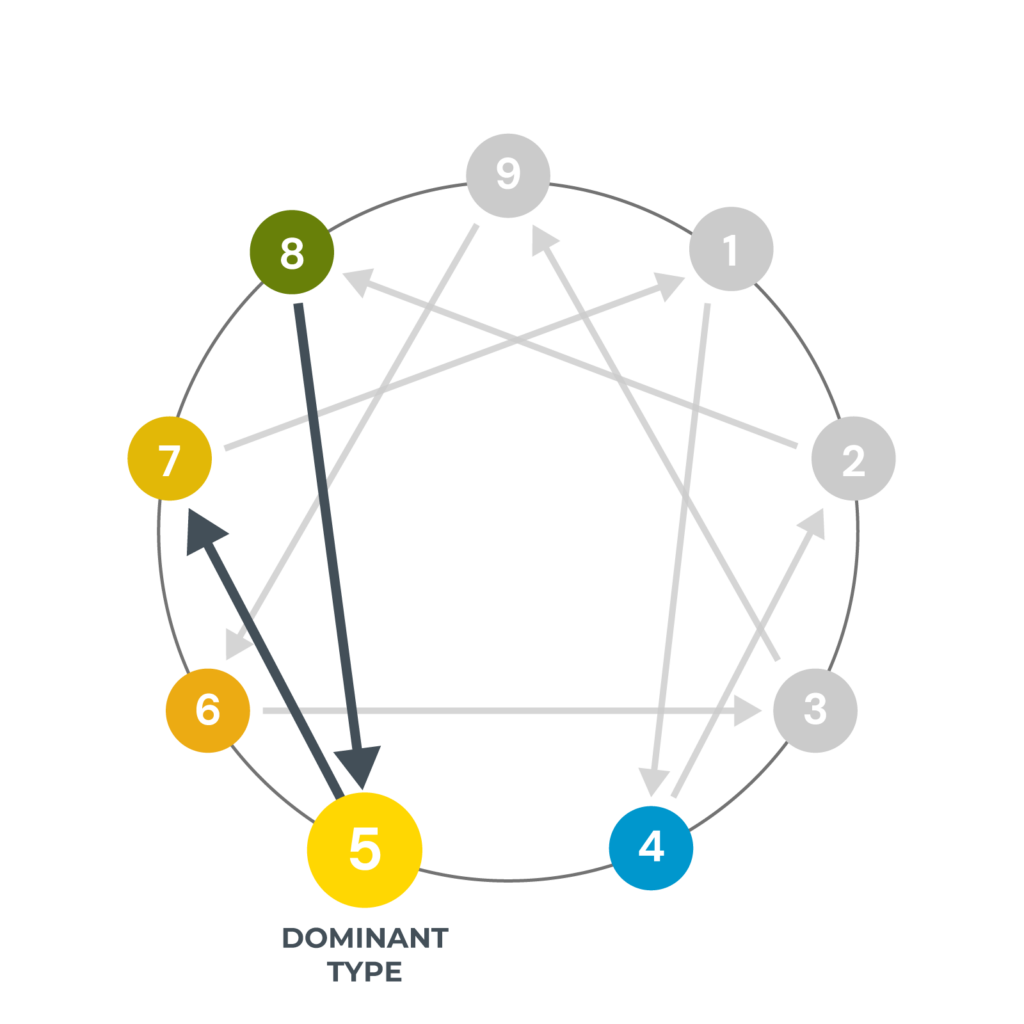
The Enneagram’s arrow lines point in the direction of each type’s specific path of psychological and spiritual growth and away from important characteristics and experiences we had to repress in childhood (but periodically return to for a sense of security). These connection points indicated by the Enneagram diagram help us see how we can aim to embody the higher aspects of these two specific points to further our inner journey: the point ahead of our core point represents key challenges we need to master to become more whole and the point behind our core type along the arrow lines represents issues from the past that we need to re-integrate such that we can reclaim what we disowned in childhood to ground and support our forward movement along the path indicated by the arrows.

Moving Back to Type 8

The path of growth for Type Fives calls for them to reclaim their ability to engage more actively, more fearlessly, and more powerfully in the world. The Eight Point can be a place of comfort for Fives who allow themselves more freedom to assert themselves and enforce the boundaries they need. The Eight archetype may also represent what didn’t work for Fives in their early environment. Fives’ early impulses to act in direct ways to get what they needed—the Eight-ish strategy of self-assertion—may not have been seen or supported in childhood, and they may have retreated when force didn’t work. However, the Eight experience likely continued to be a place Fives moved to after childhood to find comfort in feeling free to act in powerful ways to protect themselves, erect walls, or push people away.

Navigated consciously, Fives can use the “move to Eight” developmentally—to re-establish a healthy balance between withdrawing and moving out into the world. Fives can focus on the qualities and high-side traits of this “child-heart” point to understand what they may have needed to repress to get along in the world, and what they can usefully reintegrate to support their growth toward the Seven Point.

Moving back to Eight with awareness can thus be a way for Fives to reengage with their lost sense of their power and authority, a way for them to feel more strength in dealing with fear, engaging with their emotions, and interacting with others. Fives can support themselves in their self-work and expansion by consciously calling on the gifts Eights have in expressing anger in productive ways, making big things happen, and asserting themselves to impact people in positive ways. Instead of always having to survey what’s happening from a safe distance and think before doing anything, they can act more decisively in the world.

By reincorporating Type Eight attributes, Fives can consciously remind themselves that it’s okay to own your authority, express yourself more powerfully, and use strength to both make boundaries and open up to the vulnerability entailed in sharing yourself more with other people. Through owning these Eight abilities, Fives can heal any childhood hurts associated with having to hide out instead of express themselves more powerfully, and they can draw on a more present sense of their own authority to support the challenges entailed in embodying more of the idealism, optimism, and possibilities for expansion associated with the Seven Point.

Moving Ahead to Type 7

The Inner Flow growth path for Type Fives brings them into direct contact with the challenges embodied in Type Seven: using levity, sincere intellectual interest, innovative thinking, and creative options as a way of interacting more directly with the outside world. Consciously drawing on the natural strengths of the Seven archetype can help Fives see how they can engage more fully with others without having to disappear. While Fives can move to the Seven Point in times of stress, causing them to act out their nervousness in social situations through anxious laughter or a manic way of talking, they can work to ease this tension with awareness by consciously embodying aspects of the high side of Seven. Fives can expand their ability to share more of themselves with others by intentionally using humor, playfulness, and intellectual curiosity to help them to manage any anxiety they might feel when opening up more socially.

The Five working consciously in this way can make ready use of the tools healthy Type Sevens use: creative thinking and an interest in people in support of an engaged focus on interacting more deeply with others. The Seven stance has a basis in generating options as a way of seeing different ways of dealing with situations, even in the midst of underlying anxiety. The mental habits of finding connections and enthusiastically participating in the exchange of ideas can provide a good model for Fives seeking to expand their comfort zone by sharing more of themselves with others. The quick and agile way of thinking Sevens use to connect their feelings and ideas with those of others can support Fives in finding more ways to link up their own ideas and emotions more with the outside world.

Type Five Subtypes

Each Enneagram type is influenced by three instinctual drives that create distinct expressions of the type:

Self-Preservation Five

Castle

The Self-Preservation Five expresses avarice through a focus on boundaries—a need to be “encastled” in a sanctuary where they feel protected from intrusion and have control over their boundaries. SP Fives have a passion for being able to hide behind walls and know that they have everything they need to survive within those walls. They are the least expressive of the three Fives and they try to limit their needs and wants so that they can avoid being dependent on others.

Social Five

Totem

The Social Five expresses avarice through a need for “super-ideals,” relating to others with common interests through knowledge and shared values (rather than emotional connection). In this Five, avarice is connected to knowledge. Needs for people and for the sustenance that relationships provide get channeled into a thirst for information. “Totem” refers to a passion for high ideals, the need to idealize experts and seek knowledge connected to whatever ultimate values this Five adheres to. Social Fives engage in a search for the ultimate meaning to avoid experiencing life as meaningless.

Sexual/One-to-One Five

Confidence

Sexual Fives express avarice through a search for ideal exemplars of absolute love. This is a Five with a romantic streak. the name reflects their need to find a partner who fulfills an ideal of trust. The most emotionally sensitive of the Fives, they suffer more, resemble Type Four more, and have more overt desires. They have a vibrant inner life that may be expressed through artistic creation but are still cut off from others in many ways.

Continue Your Enneagram Journey

Discover more insights about Type One and explore how the Enneagram can transform your personal and professional relationships.

Get Full Report

Unlock your complete personality profile with detailed insights and growth strategies.

Team Development

Apply Enneagram insights to improve team dynamics and communication in your organization.

Coaching Sessions

Work with a certified Enneagram coach to accelerate your personal growth journey.

About the Enneagram

Enneagram Compass logo
What is the Enneagram?

Learn about how the Enneagram can help you better understand yourself and others.

3 Centers icon
Introduction to the 3 Centers

Discover the Head, Heart, and Body Centers and how they shape your core responses to the world.

Nine Types icon
Introduction to Nine Types

An overview of the nine Enneagram types and the unique traits that define each one.

3 Instincts icon
The 3 Instincts

Explore the three key instincts—Self-preservation, Social, and Sexual—and their influence on you.

27 SubTypes icon
Introduction to the 27 SubTypes

Explore the Enneagram’s 27 subtypes and how they refine the nine core types.​

Publications icon
Publications

Access books, articles, and resources from leading Enneagram experts to deepen your understanding.

Privacy Policy

We are fully compliant with the General Data Protection Regulation. Our servers are located within the EU so no data is sent outside the EU jurisdiction. Every individual has rights as to how their personal data is handled, and we recognize the need to treat all such data in an appropriate and lawful manner, according to the classification of such data. Personal data, including sensitive data, are subject to certain legal safeguards with the provisions under the GDPR and we fully comply with these legal guidelines.
 

All data (personal and otherwise) that we collect as a result of use of our Questionnaire based assessments is handled in accordance with the Privacy Policy outlined below and we can reassure you that we will not share that information for any use whatsoever other than to provide the service for which we have been contracted. This statement explains how we use the personal information that you give us. Please do not send us any personal data about anyone else without their permission.

 
Future Research and Direct Marketing Communications
 

We would like to be able to contact you in future with details of research projects we may be conducing; or in relation to further products and services that we think you may be interested in. We will only send you further emails in regards to our future research projects or marketing communications if you directly consent to us doing so- there is a specific question that asks for your consent. We will always contact you by email or other electronic means. We will treat your personal details with the utmost care and will never sell them to other companies for marketing purposes

We use MailChimp to send our email newsletters. By signing up to receive our email communications, you agree to the transfer of data to MailChimp and Active Campaign.

Updating Your Data, Erasure, and Requesting a Copy of Your Records
 

If you would like to:

  • Update your details
  • Withdraw your consent/opt out of marketing communications
  • Request erasure of the data we hold on you
  • Request a copy of the data records we hold on you (we will endeavour to fulfil the request within twenty four hours but no more than 14 days)

Please contact info@enneagramprofiling.com and we will respond within 48 hours.

Cookies

This site uses cookies – small text files that are placed on your machine to help the site provide a better user experience. In general, cookies are used to enable a client to return to the same place within a questionnaire should they be interrupted and have to discontinue the session.

Cookies can also be used to store information for things like shopping carts, and provide anonymised tracking data to third party applications like Google Analytics. As a rule, cookies will make your browsing experience better. We will send you a link to continue the questionnaire so cookies are not essential for you to enjoy our services. It may be that you may prefer to disable cookies on this site and on others. The most effective way to do this is to disable cookies in your browser. We suggest consulting the Help section of your browser or taking a look at the About Cookies website which offers guidance for all modern browsers

Data Security

At Enneagram Compass we demand the highest levels of data security. Our server provider has achieved ISO 27001 certification. We use Transport Layer Security (TLS) encryption (also known as HTTPS) for all transmitted data. Surveys can be protected with passwords and HTTP referrer checking. Our services are hosted by trusted data centres that are independently audited using the industry standard SSAE-16 method. The servers are protected by high-end firewall systems, and scans are performed regularly to ensure that any vulnerabilities are quickly found and patched.

In order to comply with GDPR we understand that data collected from the participant’s PC in Europe cannot be transferred to a server in another jurisdiction such as the US. So that we do not breach EU data protection law our server is located in Ireland. The data we collect in Europe is therefore stored and processed in Europe and is not moved to another jurisdictional area.

Disclosure – Sharing Your Data

We will not disclose your personal information to third parties except:

  • as necessary to fulfil your order(s) for our goods and services and to validate your payment details;
  • to suppliers that process data on our behalf;
  • to your coach or enneagram consultant who purchased a test on your behalf where we believe, in good faith, that it is necessary to comply with the law or to protect the safety of Enneagram Profiling, our customers or their clients, or the public.

We may use and disclose aggregated and anonymised information for marketing, product development, strategic or research purposes. In such data, no individual customer will be identifiable.

Credit Card Payments

For those using the site to purchase access to our services Stripe and PayPal are used to collect personal information related to credit card processing including . Full Name, Email Address, Billing Address, Credit Card number.

Stripe’s services in Europe are provided by a Stripe affiliate—Stripe Payments Europe Limited (“Stripe Payments Europe”)—an entity located in Ireland. In providing Stripe Services, Stripe Payments Europe transfers personal data to Stripe, Inc. in the US. To ensure the adequate protection of personal data, we have certified to the EU-U.S. and Swiss-U.S. Privacy Shield.

PayPal are still to provide their understanding of whether they are fully GDPR compliant. Their privacy policy can be read here https://www.paypal.com/uk/webapps/mpp/ua/privacy-prev . PayPal argue that they are compliant with various financial regulation laws but we suggest not using PayPal if this is something you are concerned about.

Sending Result Reports to a Third Party

Where an individual takes one of our instruments under the direction of one of our professional customers, (such as a consultant, a coach, a line manager, an Enneagram teacher etc.) and Enneagram Compass performs a service hosting, administering and scoring that instrument for the customer, then we will send the individual’s results to that customer in order that they may provide appropriate feedback, or similar service, to the individual who took the instrument. By taking the questionnaire you are giving permission for that Third Party to receive a copy of your report. In completing the questionnaire you are agreeing for the report to be sent to such a third party. We at Enneagram Profiling assume that the data will be used for the sole purpose of aiding your understanding of the Report, and in order for you to derive maximum benefit from the process. However, we do not accept any responsibility whatsoever for the actions of our third-party customers who have ordered the questionnaire and results report on your behalf. Enneagram Profiling is therefore not responsible for the use, storage or distribution of such data, or the consequences thereof that may arise as a result of the use of the report.

Retention Period – Anonymisation

Links to Other Sites