






Overview

Type Eight represents the archetype of the person who denies weakness and vulnerability by taking refuge in fearlessness, power, and strength. This archetype tends to express instinctual drives in a less inhibited way and to push back on whatever might restrict them. A personality with this archetype focuses on asserting control in big ways through an “expansive solution” characterized by domination and intensity. This approach entails identification with a glorified self (rather than a diminished sense of self).

The shades of this archetype exist in similar form in Freud’s concepts of the “id” and with his and Jung’s ideas about “libido.” These concepts seek to describe the energetic force behind the central human instinctual drives—the forceful energy or momentum that moves us to get our animal needs met undeterred. The Eight archetype thus conveys the intense drive energy within the dynamic system of the human psyche. The id is the basis of sexual energy in particular, but it is also the desire or charge or energy that motivates all action to get instinctual needs met.

Type Eights’ have an automatic ego reaction opposing any limitations on their instinctual drives causing an auto-rebellion against the rules of society or established authority. Just as Type One represents the “anti-instinctual” force within the human personality, Type Eight represents the “pro-instinctual” force inside all of us.

In addition to this human drive, the Eight archetype also represents an aspect of the masculine principle, or the animus. Just as the Type Two archetype embodies a version of “the inner feminine” principle, the Type Eight archetype communicates the archetypal idea of “the masculine” in women and in men. Naranjo points out that we can see elements of this masculine archetype in Western culture’s focus on rationality and taking action, its devaluation of softer emotions, and our prevalent ways of becoming desensitized to violence.

Type Eights are thus the prototype for that tendency in all of us to feel the need to “get big” and take the most direct route to get what we need by pushing back on internal and external forces that seek to restrain our instinctual impulses. As Enneagram scholar Sandra Maitri puts it, the Eight archetype represents our identification “with the body and with its drives and biological imperatives.” Just as the Three archetype represents the way we all take on a personality and the Four archetype highlights the universal presence of the Shadow, the Eight archetype channels the energetic momentum of our animal drives to fulfill our need to thrive and multiply. The Type Eight personality is lusty, intense, energetic, and powerful. This “under-social” stance motivates rebellion against the restrictive authority of established authorities, rules and conventions. The Type Eight habit of mind motivates them to go up against external powers and limitations both as a way of asserting their control and as a way of combating oppression and protecting the weak. This archetype is strong in people who believe in “taking justice into their own hands, rather than delegating to institutions.

As with all the archetypal personalities, however, Type Eights’ gifts and strengths also reflect their “fatal flaw” or “Achilles heel.” Their strength and power often represent overcompensation for not wanting to feel weak or own their vulnerable feelings. Accordingly, Eights may judge themselves or others for having softer feelings or expressing any kind of vulnerability. And because they deny their vulnerability—and don’t realize that true strength comes from being able to be vulnerable—they can overdo their forcefulness. Eights often fail to see the negative effects they create by expressing too much power without a balanced recognition of normal human weaknesses. They can be intense and fun-loving, but they may also be overbearing, impatient, and intolerant of frustration. However, when they can balance their personal power and strength with a more conscious awareness of their own weaknesses, vulnerabilities, and impact, they can be courageous (and even heroic) leaders, partners, and friends.

Focus of Attention

Eights naturally focus their attention on power and control—who has it and who doesn’t, and how it’s wielded.

They think in terms of the big picture and (mostly) dislike dealing with details. They see the world as being divided into “the strong” and “the weak,” and they identify with “the strong” to avoid feeling weak.

Thoughts and Emotions

Thoughts and Emotions

Emotionally, Eights usually have easy access to anger and (unconsciously) avoid registering vulnerable feelings. They typically appear fearless and can be intimidating to others, often without meaning to be. They like to be in control, engage in black and white thinking, think they know what’s best or true, and do not like to be told what to do.

Behaviour Patterns

Eights have a lot of energy, can accomplish big things, can confront others when necessary, and will protect people they care about. They can be workaholics, taking on more and more without acknowledging their physical limits, and refuse to experience vulnerable feelings that might slow them down. They can sometimes overwork themselves, even to the point of physical illness.

Blind Spots

Common Blind Spots
When Blind Spots Are Integrated

The Passion is Lust

Lust

The passion that drives Type Eight is lust. As the core emotional motivation behind this type, lust is excess—a passion for excess in all types of stimulation. It especially implies seeking excessive fulfillment through the senses or physical experience, although it does not necessarily refer to anything sexual. For Eights, lust also implies an impatience or urgency to have their desires satisfied. They don’t like to wait or negotiate or feel limited. They tend to be impatient, imposing, and rebellious against anyone who tries to limit or control them. They usually resist any constraints around pleasure and the satisfaction of their physical, emotional, and intellectual appetites—whether for food, fun, sex, or even work. They describe themselves as “working hard and playing hard,” and this reflects their lustful disposition.

The Virtue is Innocence

Innocence

Innocence is the virtue that provides an antidote to the Type Eight passion of lust. In a state of innocence, this type becomes less guarded and aggressive and gains a new-found heart-based capacity to stay undefended. This allows them to stop being so intense and excessive in life and relationships. They respond to people and situations rather than reacting to them. They have a more positive outlook and know that conditions (and people) will not be as harsh as they expect. They trust that others—and they themselves—are inherently good, not bad. They no longer need to be in charge of everything or override life’s natural rhythms. They realize that, if they stay non-reactive and disclose themselves to others more, they will not be attacked. They, in a sense, learn to disarm others by putting down their own weapons first. And they no longer allow other people’s aggression to determine their state of being.

Discover Your Full Personality Profile

Get a comprehensive analysis of your type, including personalized growth strategies and relationship insights.

Growth Path

As Eights work on themselves and become more self-aware, they learn to escape the trap of limiting themselves through opposing limits on themselves by developing a clearer awareness of their softer side, tempering action with more thinking and feeling, and learning to moderate their impulses and impact.

For Eights, the growth process involves observing the ways in which they express their power and avoid feeling weak and dependent; exploring how they deny the deeper truth of early and ongoing hurts and overcompensate through being strong; and making active efforts to balance their forcefulness and autonomy with a greater awareness of their emotional depths and relational capacities.

It is particularly important for Eights to develop a more direct relationship with their vulnerability and to have the strength to be seen as weak.

Wings and Arrows

In using the Enneagram to further growth, as it is intended, the first steps involve observing yourself to make the patterns and habits associated with your main, or “core,” type more conscious.

After you have done this for a while, you can create further growth shifts by using the wings and arrows as pathways for growth.

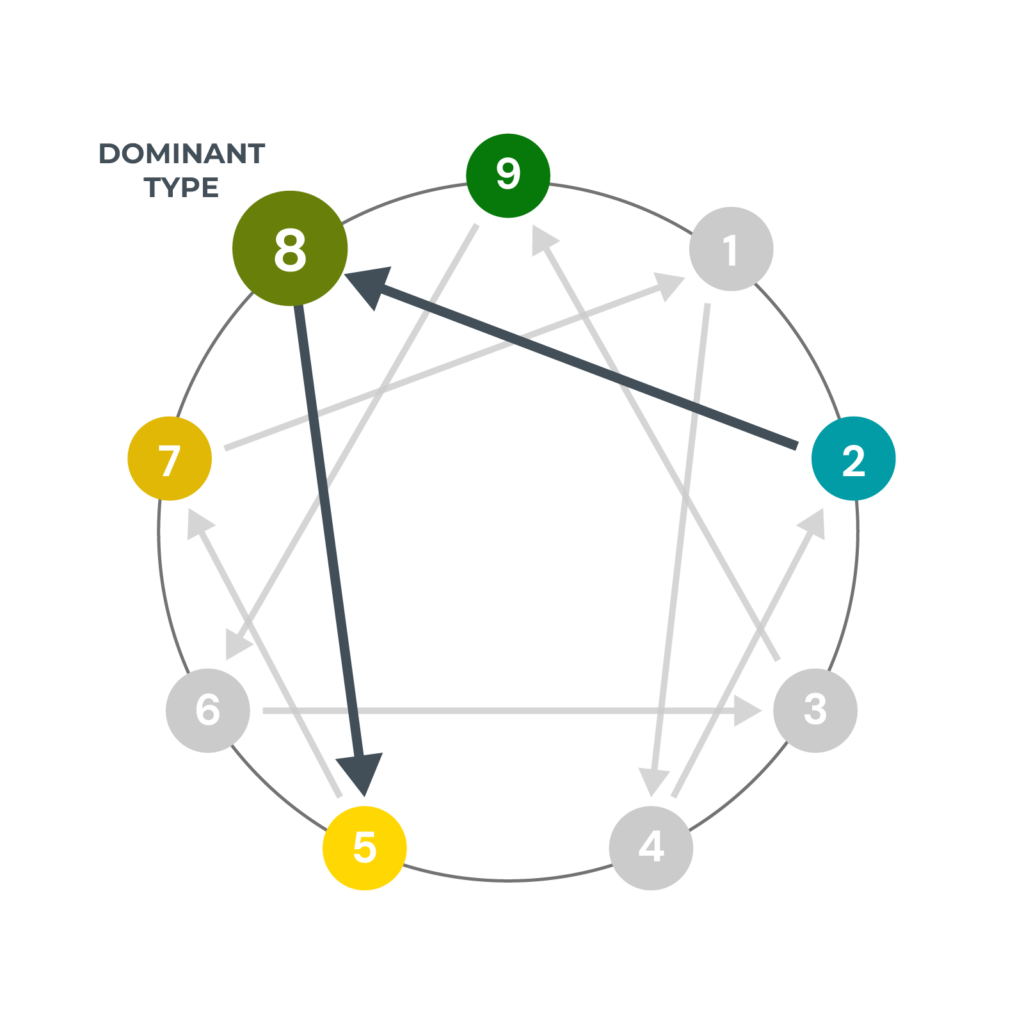
The Enneagram’s arrow lines point in the direction of each type’s specific path of psychological and spiritual growth and away from important characteristics and experiences we had to repress in childhood (but periodically return to for a sense of security). These connection points indicated by the Enneagram diagram help us see how we can aim to embody the higher aspects of these two specific points to further our inner journey: the point ahead of our core point represents key challenges we need to master to become more whole and the point behind our core type along the arrow lines represents issues from the past that we need to re-integrate such that we can reclaim what we disowned in childhood to ground and support our forward movement along the path indicated by the arrows.

Moving Back to Type 2

The path of growth for Type Eights calls for them to reclaim their ability to actively open up to their empathy for others and their need to be appreciated. Eights’ early impulses to be seen and loved by others were not particularly recognized and supported in childhood. As children, Eights may have felt that they had to decide between the vulnerability of needing affection and the power of not needing anything from anybody – and they chose to take refuge in a position of strength.

Without awareness around the move to Type Two, Eights can act out the Two habits of “giving to get” and seducing through charm and helpfulness. They may compulsively and expansively do things for others, give advice, or express physical affection as a way of forging connections. Eights may go to Two in anxious ways—in an unconscious search for the comfort of relationship when they are stressed—or as a way to act out the disowned need for love they usually don’t allow themselves to feel. As Sandra Maitri observes, “within the tough and no-nonsense Eight who delights in testing her grit…dominating and controlling life, and triumphing over adversity, lies a needy, clingy and lonely little Two-ish child who is desperate to be loved and held.”

Navigated consciously, however, Eights can use the move to Two developmentally, to reestablish a healthy balance between attuning to others’ feelings and needs and asserting their own needs. Eights can focus on the qualities of this “child–heart” point to understand the needs they may have had to deny in themselves in their youth in order to get along in the world. Moving back to Two can thus be a way for Eights to consciously re-engage a lost sense of their needs for comfort, love, and care, and their desire to adapt to and please others as a way of relating.

By reincorporating Type Two qualities, Eights can consciously remind themselves that it’s okay to care about what other people think and feel about you; and that it’s important to value your needs for love, understanding, affection, and acceptance. Instead of hiding their need for love and connection in a pose of strength and autonomy, Eights can seek to embody the high side of Two and open up a channel to loving and supportive relationships. They can use the wisdom of Two to adapt to meet the needs of others and to express their care and affection to other people more consciously. In this way, Eights can balance their talent for acting boldly in the world with the capacity for experiencing the vulnerability of needing support and care. They can use their Two “child–heart” point as a way of reclaiming their inner child’s need for care and affection and opening up to a deeper participation in the give-and-take of loving relationships.

Moving Ahead to Type 5

The Inner Flow growth path for Type Eights brings them into direct contact with the challenges embodied in Type Five, allowing for a balance between withdrawal and forward momentum and between thinking and acting as a way to marshal inner resources to develop “nonattachment.” Not surprisingly, the Eight move to Five may represent an extreme response to an intense experience of stress, as it can be a mode of retreat that Eights are driven to when their normal reliance on power and action has failed. To the normally expressive Eight, the experience of Five may feel like a bunker where they take shelter when threatened or when conditions have dealt them a severe setback. The Five Point offers Eights a way to protect themselves through withdrawal to a remote place of safety where they can regroup rather than use power and strength. But this experience of Five, when consciously and mindfully managed, can help Eights develop a capacity for careful analysis conducted from a distance in place of overreliance on force, aggression, and bold (sometimes precipitous) action to get what they need.

The Eight working consciously in this way can make ready use of the tools healthy Fives use: analytical skills and economical use of energy and resources in support of self-protection and self-expression. The Five stance has a basis in observation, objective thinking, and a cautious focus on boundaries, and it can serve to balance out Eights’ tendencies toward impulsivity, excess, and intimidation. Fives’ judicious use of inner resources can help Eights focus more intentionally on self-regulation and moderation in the things they do. The mental activity, conscientious research, and planning characteristic of Fives can remind Eights to think more thoroughly about what they want to do before they move into action. And the way in which Fives automatically prioritize their own safety, maintaining a safe distance from danger, can help Eights develop a more conscious ability to take care of their “inner child.” Valuing their need for time alone, energetic self-regulation, and personal space balances the Eights habitual reliance on brute force and over-action.

Type Eight Subtypes

Each Enneagram type is influenced by three instinctual drives that create distinct expressions of the type:

Self-Preservation Eight

Satisfaction

Self-Preservation Eights express the passion of lust through a focus on getting what they need for survival. SP Eights have a strong desire for the timely satisfaction of material needs and an intolerance for frustration. SP Eights know how to survive in difficult situations and feel omnipotent when it comes to getting what they need. They are the least expressive and the most armed of the three Eight subtypes.

Social Eight

Solidarity

Social Eights express lust and aggression in the service of others. A social antisocial person, this is the countertype of the Eights, a helpful Eight who appears less aggressive and more loyal than the other two Eight subtypes. The name “Solidarity” emphasizes their tendency to offer help when people need protection.

Sexual/One-to-One Eight

Possession

Sexual Eights express lust through rebellion and the need to possess everyone’s attention. Sexual Eights are intense, charismatic characters who want to have control and influence. Instead of seeking material security, they try to get power over things and people. The name “Possession” refers to an energetic takeover of the whole scene—a need to feel powerful through dominating the whole environment.

Continue Your Enneagram Journey

Discover more insights about Type One and explore how the Enneagram can transform your personal and professional relationships.

Get Full Report

Unlock your complete personality profile with detailed insights and growth strategies.

Team Development

Apply Enneagram insights to improve team dynamics and communication in your organization.

Coaching Sessions

Work with a certified Enneagram coach to accelerate your personal growth journey.

About the Enneagram

Enneagram Compass logo
What is the Enneagram?

Learn about how the Enneagram can help you better understand yourself and others.

3 Centers icon
Introduction to the 3 Centers

Discover the Head, Heart, and Body Centers and how they shape your core responses to the world.

Nine Types icon
Introduction to Nine Types

An overview of the nine Enneagram types and the unique traits that define each one.

3 Instincts icon
The 3 Instincts

Explore the three key instincts—Self-preservation, Social, and Sexual—and their influence on you.

27 SubTypes icon
Introduction to the 27 SubTypes

Explore the Enneagram’s 27 subtypes and how they refine the nine core types.​

Publications icon
Publications

Access books, articles, and resources from leading Enneagram experts to deepen your understanding.

Privacy Policy

We are fully compliant with the General Data Protection Regulation. Our servers are located within the EU so no data is sent outside the EU jurisdiction. Every individual has rights as to how their personal data is handled, and we recognize the need to treat all such data in an appropriate and lawful manner, according to the classification of such data. Personal data, including sensitive data, are subject to certain legal safeguards with the provisions under the GDPR and we fully comply with these legal guidelines.
 

All data (personal and otherwise) that we collect as a result of use of our Questionnaire based assessments is handled in accordance with the Privacy Policy outlined below and we can reassure you that we will not share that information for any use whatsoever other than to provide the service for which we have been contracted. This statement explains how we use the personal information that you give us. Please do not send us any personal data about anyone else without their permission.

 
Future Research and Direct Marketing Communications
 

We would like to be able to contact you in future with details of research projects we may be conducing; or in relation to further products and services that we think you may be interested in. We will only send you further emails in regards to our future research projects or marketing communications if you directly consent to us doing so- there is a specific question that asks for your consent. We will always contact you by email or other electronic means. We will treat your personal details with the utmost care and will never sell them to other companies for marketing purposes

We use MailChimp to send our email newsletters. By signing up to receive our email communications, you agree to the transfer of data to MailChimp and Active Campaign.

Updating Your Data, Erasure, and Requesting a Copy of Your Records
 

If you would like to:

  • Update your details
  • Withdraw your consent/opt out of marketing communications
  • Request erasure of the data we hold on you
  • Request a copy of the data records we hold on you (we will endeavour to fulfil the request within twenty four hours but no more than 14 days)

Please contact info@enneagramprofiling.com and we will respond within 48 hours.

Cookies

This site uses cookies – small text files that are placed on your machine to help the site provide a better user experience. In general, cookies are used to enable a client to return to the same place within a questionnaire should they be interrupted and have to discontinue the session.

Cookies can also be used to store information for things like shopping carts, and provide anonymised tracking data to third party applications like Google Analytics. As a rule, cookies will make your browsing experience better. We will send you a link to continue the questionnaire so cookies are not essential for you to enjoy our services. It may be that you may prefer to disable cookies on this site and on others. The most effective way to do this is to disable cookies in your browser. We suggest consulting the Help section of your browser or taking a look at the About Cookies website which offers guidance for all modern browsers

Data Security

At Enneagram Compass we demand the highest levels of data security. Our server provider has achieved ISO 27001 certification. We use Transport Layer Security (TLS) encryption (also known as HTTPS) for all transmitted data. Surveys can be protected with passwords and HTTP referrer checking. Our services are hosted by trusted data centres that are independently audited using the industry standard SSAE-16 method. The servers are protected by high-end firewall systems, and scans are performed regularly to ensure that any vulnerabilities are quickly found and patched.

In order to comply with GDPR we understand that data collected from the participant’s PC in Europe cannot be transferred to a server in another jurisdiction such as the US. So that we do not breach EU data protection law our server is located in Ireland. The data we collect in Europe is therefore stored and processed in Europe and is not moved to another jurisdictional area.

Disclosure – Sharing Your Data

We will not disclose your personal information to third parties except:

  • as necessary to fulfil your order(s) for our goods and services and to validate your payment details;
  • to suppliers that process data on our behalf;
  • to your coach or enneagram consultant who purchased a test on your behalf where we believe, in good faith, that it is necessary to comply with the law or to protect the safety of Enneagram Profiling, our customers or their clients, or the public.

We may use and disclose aggregated and anonymised information for marketing, product development, strategic or research purposes. In such data, no individual customer will be identifiable.

Credit Card Payments

For those using the site to purchase access to our services Stripe and PayPal are used to collect personal information related to credit card processing including . Full Name, Email Address, Billing Address, Credit Card number.

Stripe’s services in Europe are provided by a Stripe affiliate—Stripe Payments Europe Limited (“Stripe Payments Europe”)—an entity located in Ireland. In providing Stripe Services, Stripe Payments Europe transfers personal data to Stripe, Inc. in the US. To ensure the adequate protection of personal data, we have certified to the EU-U.S. and Swiss-U.S. Privacy Shield.

PayPal are still to provide their understanding of whether they are fully GDPR compliant. Their privacy policy can be read here https://www.paypal.com/uk/webapps/mpp/ua/privacy-prev . PayPal argue that they are compliant with various financial regulation laws but we suggest not using PayPal if this is something you are concerned about.

Sending Result Reports to a Third Party

Where an individual takes one of our instruments under the direction of one of our professional customers, (such as a consultant, a coach, a line manager, an Enneagram teacher etc.) and Enneagram Compass performs a service hosting, administering and scoring that instrument for the customer, then we will send the individual’s results to that customer in order that they may provide appropriate feedback, or similar service, to the individual who took the instrument. By taking the questionnaire you are giving permission for that Third Party to receive a copy of your report. In completing the questionnaire you are agreeing for the report to be sent to such a third party. We at Enneagram Profiling assume that the data will be used for the sole purpose of aiding your understanding of the Report, and in order for you to derive maximum benefit from the process. However, we do not accept any responsibility whatsoever for the actions of our third-party customers who have ordered the questionnaire and results report on your behalf. Enneagram Profiling is therefore not responsible for the use, storage or distribution of such data, or the consequences thereof that may arise as a result of the use of the report.

Retention Period – Anonymisation

Links to Other Sites